Overview and History
The Vermont Breeding Bird Atlas (VBBA) is the most comprehensive bird survey in the state, and occurs only once every 25 years. The first Atlas in Vermont was published in 1985, and in 2002, we embarked on the second. From 2003 to 2007, volunteers from every corner of the state surveyed the variety of habitats Vermont offers, from forests and fields to valleys and mountains, keeping record of the birds they found. The Atlas field surveys took place over 5 years to allow enough time to cover all of the regions of the state that were surveyed a quarter century ago.
Summary of Results
- Effort During Second Atlas
- Comparing Effort Between First and Second Atlas
- Patterns of Species Richness
- Changes Between First and Second Atlases
- Species Groups
- Gains and losses from first Atlas to second Atlas
- Species and confirmations from second Atlas
- Species Accounts
What Were the Objectives of the Atlas?
The main goal of the first Atlas was to document the spatial distribution of each bird species at a broad geographical scale. Our primary goal for the second generation Atlas was to survey the same lands in Vermont that were surveyed 25 years ago in order to detect changes in the distribution of species. Other goals of the second Atlas included:
- identify rare species and important breeding areas for birds
- provide data for species and groups of species not adequately surveyed by other existing surveys
- enhance public awareness of birds through presentations, workshops and field trips
- expand the existing network and skill level of citizen scientists in Vermont by encouraging participation in this project
- combine data from atlases carried out in the same region to assess distributional changes at a broader scale
What DID We Accomplished?
Given the incredible growth in recreational birding since the first Atlas, we were able to garner enough volunteer support to survey twice the land area that was covered in the first Atlas. From the data collected, we produced maps depicting the occurrence of every species breeding in the state. The maps and other data generated from this work have been distributed to state agencies, planners, educators, and organizations to aid in species management and recovery, to carry out planning, and to prioritize conservation that will maintain or enhance Vermont’s bird populations.
Atlas data have provided essential foundations for Endangered Species recovery and management plan development. Vermont’s Species Advisory Group (SAG) on birds uses Atlas data to make science-based recommendations to the Vermont Endangered Species Committee regarding species to be listed as Threatened or Endangered, and maintains its own internal list of Special Concern Species to monitor.
Atlas data from Vermont have also been used for a variety of research and conservation applications ranging from evaluations of single species to patterns of biodiversity at state, regional, and national scales. Projects such as monitoring forest ecological integrity in northern New England, assessing thresholds at which habitat fragmentation impacts forest bird species, determining the extent to which resource extraction and biodiversity conservation are compatible, and evaluating small-scale avian range shifts in response to localized climactic changes. At the state scale, Atlas data may help determine the primary factors that explain species richness patterns and whether common species contribute more to these patterns than rare species.
Perhaps of greatest importance are the ways in which Atlas data and interpretations are used as a basic and essential source of information. They are an important reference consulted by conservationists, planners, developers, land managers, educators, students, biologists, wildlife watchers, media outlets, and outdoor enthusiasts. These data offer a unique, comprehensive view of broad changes in the status and distribution of Vermont’s breeding bird species.
Advisory Committee
Coordinators and Atlasers
Authors, Reviewers, and Proofers
Cooperators
Vermont Fish & Wildlife Department
USGS-Patuxent Wildlife Research Center (PWRC) and National Biological Information Infrastructure (NBII)
The Rubenstein School of Environment and Natural Resources at the University of Vermont
Audubon Vermont
Northwoods Stewardship Center
Vermont Institute of Natural Science (VINS)
North Branch Nature Center
Sponsors
Major financial support was provided by the Vermont Fish and Wildlife Department, the Nongame Wildlife Fund, the State Wildlife Grants (SWG) Program, and by individual donors.
Vermont Botanical and Bird Club
Mascoma Savings Bank
Velco
groSolar
Galbraith Environmental Services
esri
Vermont Woods Studio
Major Funding Contributors
McCormick Foundation
In loving memory of Bird, a passionate birder and conservationist who embodied citizen science long before the term was coined.
Byrne Foundation
Emily Landecker Foundation
Lintilhac Foundation
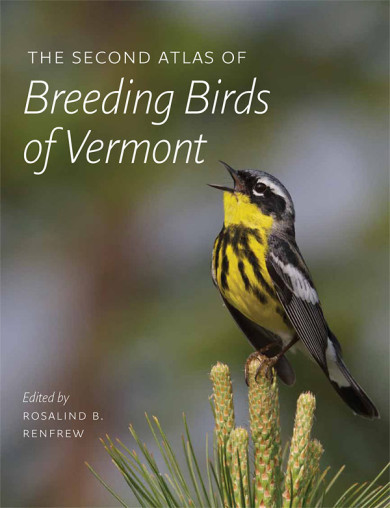
Published Atlas Book
- Renfrew, R. B., ed. 2013. The Second Atlas of Breeding Birds of Vermont. University Press of New England, Hanover, NH. 548 pp. https://doi.org/10.6084/m9.figshare.11499330.v1