Summary
- Natural history: The Great Egret, long the emblem of the National Audubon Society, has traditionally nested along the warm coastal wetlands of the southeastern United States, so the growing number turning up in the Champlain Valley in recent decades hints that the species’ breeding range may be sliding northward as the climate warms. Vermont’s egrets nest almost entirely within mixed colonies of Great Blue Herons or Black-crowned Night-Herons, with breeding first confirmed at Missisquoi National Wildlife Refuge in 1977 but not repeated there until 2004. Even at their strongest colony, on New York’s Four Brothers Islands, the egrets are squeezed onto a single small island whose buckthorn trees are being killed off by more than 1,200 nesting cormorants, showing how competition with other waterbirds now shapes where Great Egrets can nest on Lake Champlain.
- Status in VT: Has been observed with increasing regularity in Champlain Valley. Breeding first confirmed in 2004 and again in 2010 at Missisquoi NWR.
- Data from other research: No additional data for VT.
- Conservation status: State rank S1B
- Other atlases: NY: 59%; PA: 228%
- VT’s role in North American range: Breeding occurs sporadically on Champlain Islands.
- Causes of change since first Atlas: No change.
- Management/Monitoring recommendations:No current recommendations.
First Vermont Breeding Bird Atlas (1976-1981)
Second Vermont Breeding Bird Atlas (2003 – 2007)
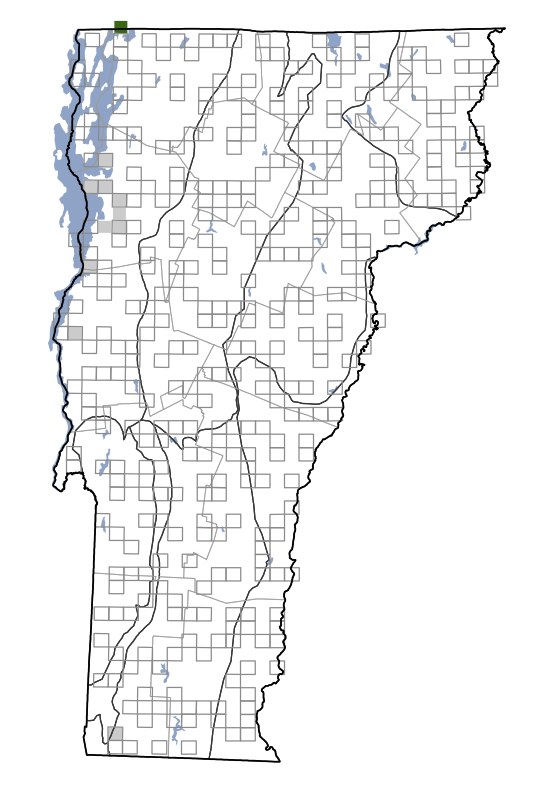

Change in Distribution