Summary
- Natural history: The Caspian Tern is the world’s largest tern, easily recognized by its heavy red bill, and did not begin nesting on Lake Champlain until 2000, when a pair set up on Young Island after years of increasingly frequent summer sightings. It is almost entirely a fish eater, and its recent spread around the Great Lakes has been credited partly to a booming population of invasive alewife providing an easy new food source alongside native smelt. Vermont’s toehold population remains fragile, vulnerable to disturbances from nearby cormorant and gull control efforts and to the kind of disease outbreaks that killed hundreds of adult Caspian Terns on a single New York island in the mid-2000s.
- Status in VT: Rare breeder on Lake Champlain islands. First breeding record in Vermont in 2000.
- Data from other research: No additional data for VT.
- Conservation status: State rank S1B
- Other atlases: NY: increased from 3 to 5 blocks; ON: population expanding
- VT’s role in North American range:Population is widely dispersed, particularly along the Atlantic coast.
- Causes of change since first Atlas: Minimal change. Population seems to be slowly increasing on Lake Champlain islands in both NY and VT.
- Management/Monitoring recommendations: No current recommendations.
First Vermont Breeding Bird Atlas (1976-1981)
No Species Account Available
Second Vermont Breeding Bird Atlas (2003 – 2007)


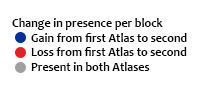
Change in Distribution