Three Rare Native Bees Found in Vermont for the First Time
After a decade of work, our Vermont Wild Bee Survey had found that 352 wild bee species call Vermont home, with 60% of those species likely in need of conservation action. But we knew there were more native bees to be found. One area we predicted might harbor some rare species of conservation concern was the far southeastern corner of Vermont.
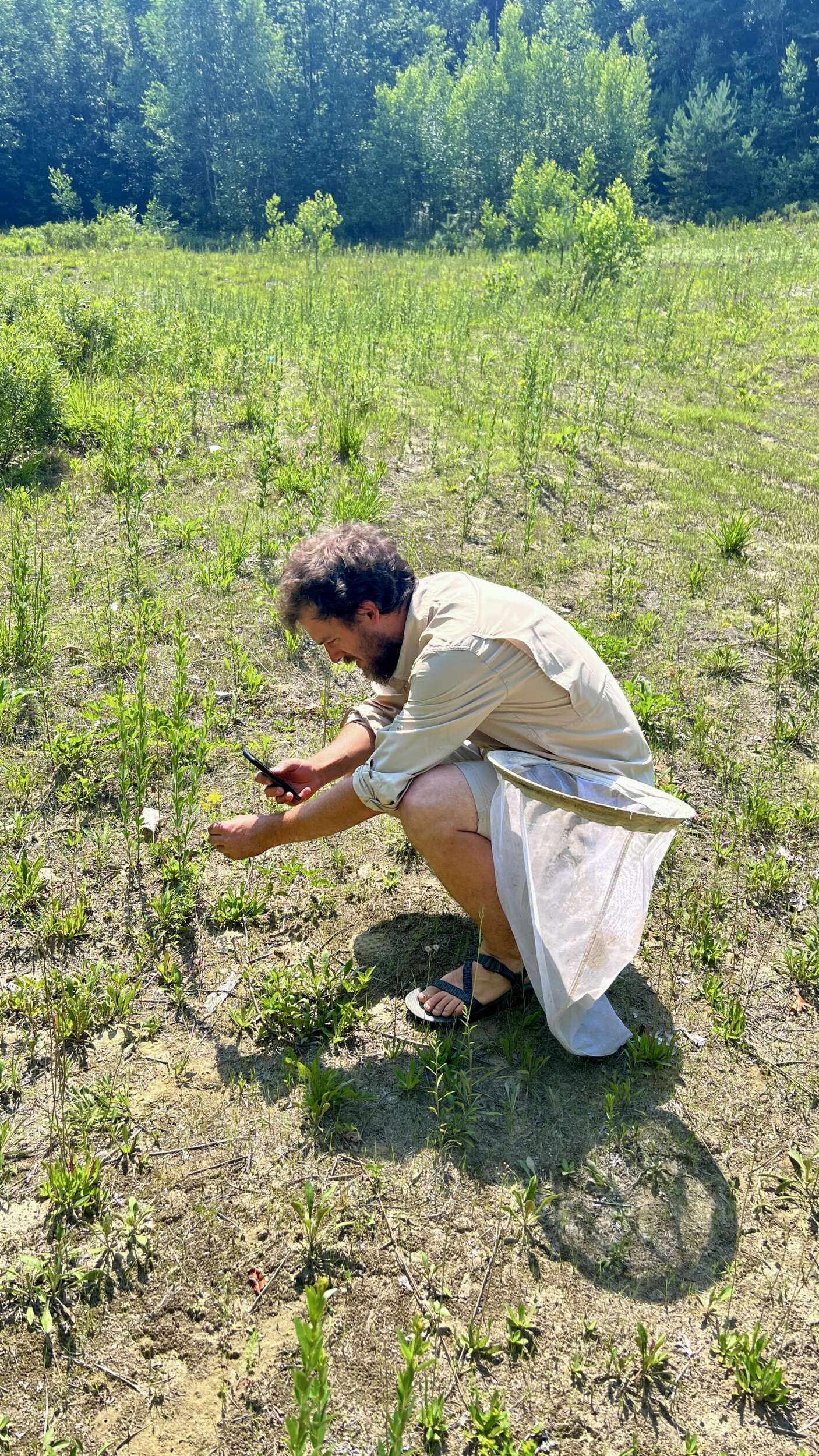
Spencer Hardy surveying bees.
On a hot June day, I accompanied our bee expert, Spencer Hardy, to help him survey a powerline right-of-way that likely had some specific native plants that some rare bees used. If we were lucky, we might find some native bee species that have never been documented in the state.
Spencer’s expertise and homework paid off. He netted three — well, two confirmed and one that got away — new bees for Vermont along one stretch of brushland created by the right-of-way.
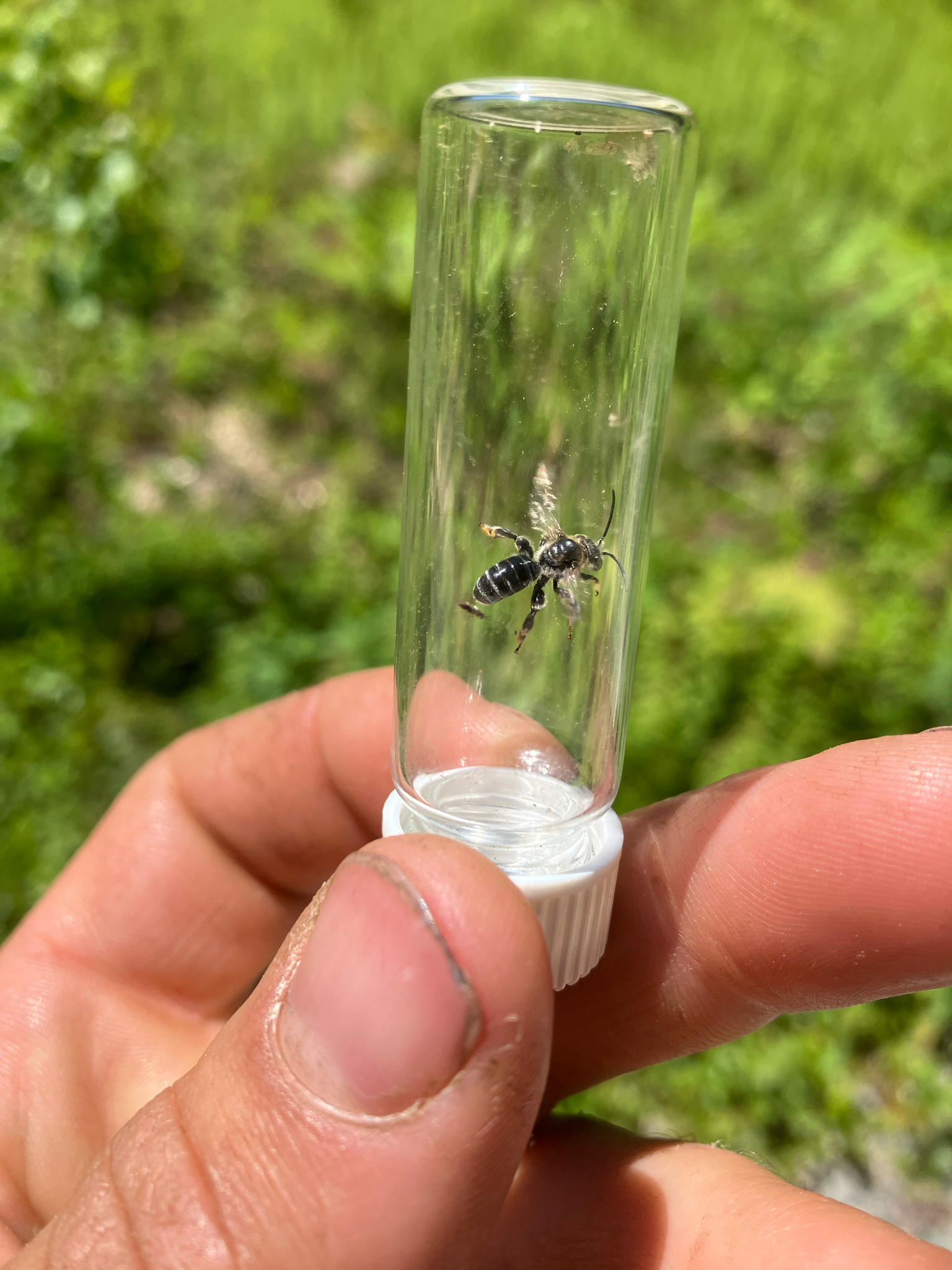
The first state record of Fringed Loosestrife Oil Bee captured to identify and photograph.
Fringed Loosestrife Oil Bee (Macropis ciliata) is a specialist forager on native, oil-producing loosestrifes. There is some evidence that they were once more common and widespread across their range. Spencer found several males patrolling a patch of Whorled Loosestrife (Lysimachia quadrifolia).
Loosestrife bees are among the rarest bees in the Northeast. They are unique in collecting oils and pollen from native Loosestrifes (Genus Lysimachia) and are thus dependent on these yellow flowers.
Whorled Loosestrife (Lysimachia quadrifolia) has specialized glandular hairs on its petals (called trichome elaiophores) that secrete floral oils instead of nectar. These oils serve as a vital reward for specialist Macropis bees, which use the lipids for larval food and to waterproof their underground nests.
The hind scopae (dense, brush-like tufts of specialized hairs found on the hind legs) of oil-collecting bees like Macropis are a silvery mat of short, finely dissected hairs that wick and hold the oils. Stiff, unbranched hairs support these oil-laden hairs. The bees deliver this to shallow nests they build in the ground, often in aggregations.
Maleberry, aka He-Huckleberry (Lyonia ligustrina), is the only species of Lyonia occurring in Vermont. It’s a mid-sized shrub related to blueberries that is fond of wet forests and marshes, and found primarily in southern Vermont. It blooms mid June through early July and is host to three specialist bees. All of them occur in Massachusetts, and just one, Lyonia Blunt-horn (Melitta melittoides), has been found in Vermont…until now.
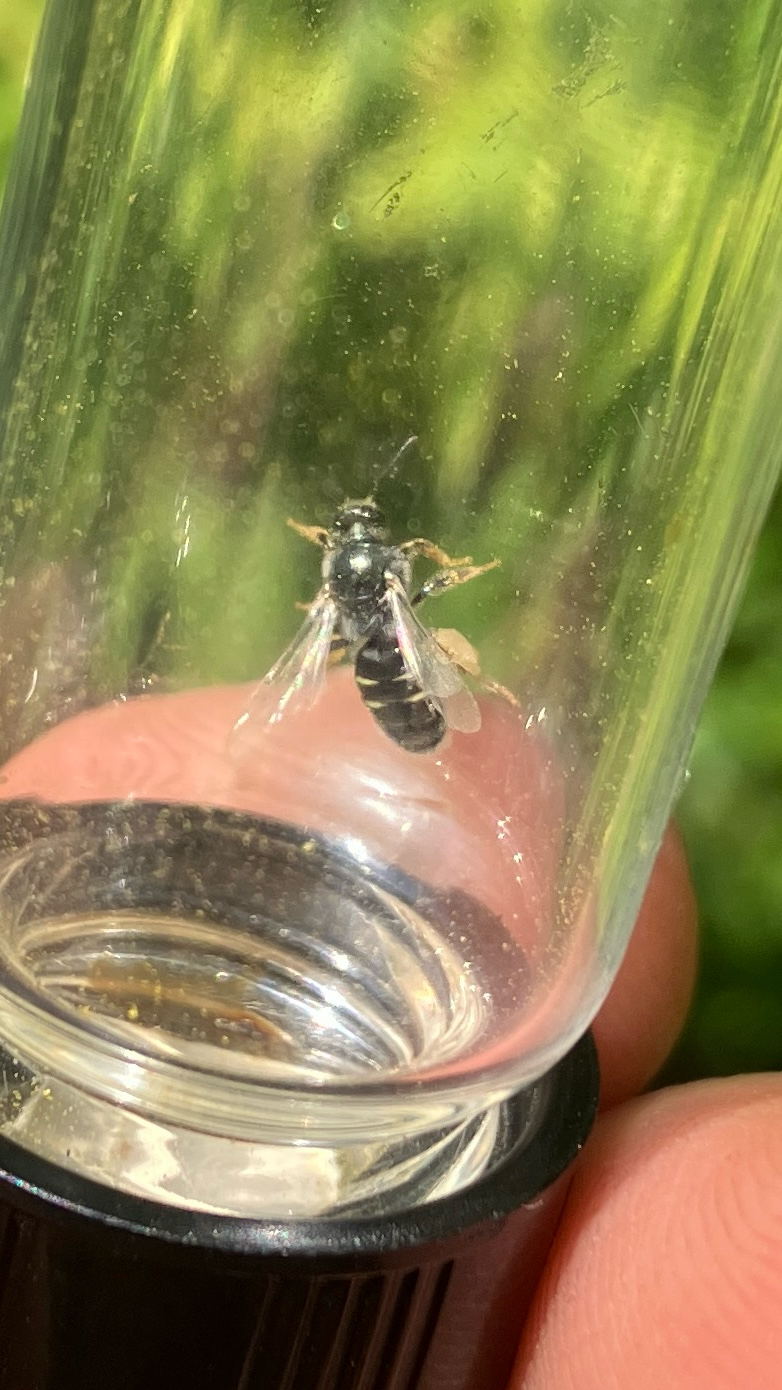
New England Fairy Bee captured for identificaiton and photography.
New England Fairy Bee (Perdita novaeangliae) are like other bees in the genus, as miniscule as is the flower they forage upon.These bees are oligoleges, meaning females are very specialized and only collect pollen from Lyonia shrubs. Spencer found a single female on a flowering Maleberry bush.
Lyonia Cellophane Bee (Colletes productus) is another specialist on Lyonia shrubs. The bee’s highly elongated face may be an evolutionary adaptation for feeding from the tiny Maleberry flower openings. Spencer briefly watched and then netted a female that appeared to be a cellophane bee on a flowering Maleberry before it slipped free. Given the date and host plant, it was almost certainly the Lyonia Cellophane Bee, but it will have to live on the “hypothetical” list for at least another year. All the more reason to keep hunting!
This field work, in partnership with the Vermont Fish & Wildlife Department, is part of our effort to better understand some conservation concern species that are poorly understood or unknown but likely occur here. We aim to fill in the distribution and abundance data gaps for areas, habitats, and species that were poorly represented in recent bee surveys.
Whether rare or common, we encourage everyone to photograph and submit observations of bees to iNaturalist Vermont wherever they are encountered.