This survey represents countless hours of work from hundreds of people. Each of the thousands of bee records that form the backbone of this study are by themselves a collaboration of many individuals and organizations. Each record starts with either a photograph or specimen collected in the field, often by a volunteer or scientist working on their own project. Then it is identified by at least one expert taxonomist, who is basing their work on more than a century of prior taxonomic work. Finally, it is digitized and shared as open-access data with the Vermont Atlas of Life (VAL) and the Global Biodiversity Information Facility (GBIF).
 Spencer Hardy – Project Lead
Spencer is a biologist and the VTBees coordinator. He has been researching native bees for over a decade, along with surveying birds and alpine butterflies. Spencer worked for several seasons in California with bumble bee and pollinator studies, and worked on the Vermont Bumble Bee Atlas for VCE. His interest in pollinators is motivated both by a fascination with small, under-appreciated organisms and a selfish desire to preserve the tasty fruits and vegetables that depend on them. He also grows native plants and exotic fruit as a co-owner of The Farm Upstream in Jericho, Vermont. Learn more on the VCE website.
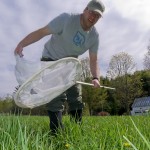 Kent McFarland – Co-lead
A co-founder of the Vermont Center for Ecostudies and director of the Vermont Atlas of Life, Kent is a conservation biologist and he has been on the State Advisory Group for Invertebrates for the Vermont Endangered Species Committee since 2002. He’s spearheaded the Vermont butterfly, bumble bee, and other Vermont Atlas of Life projects. Learn more on the VCE website.

Michael Hallworth – Data Scientist
Mike is a wildlife ecologist whose research aims to understand the interplay between the environment and population demography. He works to understand the full annual cycle of animal movement at multiple spatial scales—from fine-scale habitat selection of individuals to intercontinental migrations of populations. Identifying how different phases of the annual cycle interact to shape individual, population, and community dynamics is essential to understand how wildlife populations—including wild bees—respond to global change. Learn more on the VCE website.

Leif Richardson – Project Advisor
Leif is a Conservation Biologist with the Xerces Society for Invertebrate Conservation. His research focuses on the ecology, distribution, and declines of North American bumble bees. He has previously worked on VCE’s Vermont Bumble Bee Atlas and as an ecologist with the Vermont Nongame and Natural Heritage Program. Leif’s is a co-author of Bumble Bees of North America: an Identification Guide. Learn more on Leif’s website
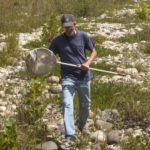 Mark Ferguson – Natural Heritage Zoologist – Project Advisor
Mark is a wildlife biologist with the Vermont Fish & Wildlife Department and serves as zoologist with the Department’s Natural Heritage Inventory. His work takes him into woods, fields, and waters in search of rare fish, amphibians, and invertebrates. He helps shape both state and Northeast regional efforts to conserve and restore vulnerable wildlife populations.
Taxonomic Experts
The following people have been invaluable in assisting with bee identification, without which this project would not be possible.
- John Ascher, National University of Singapore
- Sam Droege, USGS Native Bee Inventory and Monitoring Program
- Jason Gibbs, University of Manitoba
- Joan Milam, University of Massachusetts Amherst
- Michael Veit
- Max McCarthy, Rutgers University
- Joel Neylon
- Kyle Price
- Xian Zhou
- Brian Dagley
- Thomas Onuferko, Canadian Museum of Nature
- Zachary Portman, University of Minnesota
Additionally, over 1,000 people from all over the world have contributed identifications through iNaturalist .
Volunteer Community Scientists
We are grateful to the nearly 3,000 naturalists that contributed bee observations to this study via iNaturalist, with particular thanks to Bernie Paquette, Erika Mitchell, Doug Burnham, Eve Mendelsohn, Lisa Cass, Mike Kiernan, Joshua Lincoln, Bruce Cook, and David Hoag. Additionally, the following community scientists contributed significantly to our collection efforts; Deb Laramie, Jody Frey, Andrée Sanborn, Elizabeth Hunton, Lynn and Dick Ruben, Michael Sabourin, Don Miller, Janet Hardy, Karen Bourque, Doug and Mary Burnham, Kevin Downey, Betsy and Jim Bahrenburg, Neil Buckley, James and Cynthia Hall, Bobbi Holzel, Sabina Ernst, Mark and Peggy Faucher, and Ray Gonda.
Other Biologists and Institutions
Tim Duclos (Merck Forest and Farmland Center), Judy Sefchick (Missisquoi National Wildlife Refuge), Jason Hill (Vermont Center for Ecostudies), and Jason Mazurowski, Charlie Nicholson, and Taylor Ricketts (University of Vermont) also added valuable occurrence records over multiple seasons. We thank our interns Colin Brown (University of Vermont), Claire Contreras (Middlebury College), and Katie McGranaghan (Community College of Vermont) for their dedicated work.
These museums and collections in Vermont graciously allowed us access and lent us specimens to determine, database, and publish to GBIF: University of Vermont Natural History Museum – Zadock Thompson Zoological Collection, University of Vermont George D. Aiken Forestry Sciences Laboratory Collections, Middlebury College Insect Collection, and Fairbanks Museum and Planetarium. We also thank the work of many collections around the world that digitized and shared Vermont records with GBIF and other open-access data portals.
We thank the many private landowners that graciously gave us permission to survey wild bees on their property. The following organizations and agencies permitted access to their lands for this project: The Nature Conservancy; Vermont Department of Forests, Parks, and Recreation; Vermont Fish and Wildlife Department; Green Mountain National Forest; Vermont Air National Guard; Vermont Army National Guard; Missisquoi National Wildlife Refuge; Silvio Conte National Wildlife Refuge; Merck Forest and Farmland Center; Vermont Land Trust; and others.
Funding
VTBees is a project of the Vermont Atlas of Life at the Vermont Center for Ecostudies in partnership with the Vermont Fish & Wildlife Department and collaboration from the University of Vermont Gund Institute for the Environment. Financial support has been provided by a State Wildlife Grant from the Vermont Fish & Wildlife Department, the Binnacle Family Foundation, the Kelsey Trust, Missisquoi National Wildlife Refuge, NatureServe, Riverledge Foundation, the Sarah K. deCoizart Article Tenth Perpetual Charitable Trust, and generous contributions from Vermont Center for Ecostudies supporters.