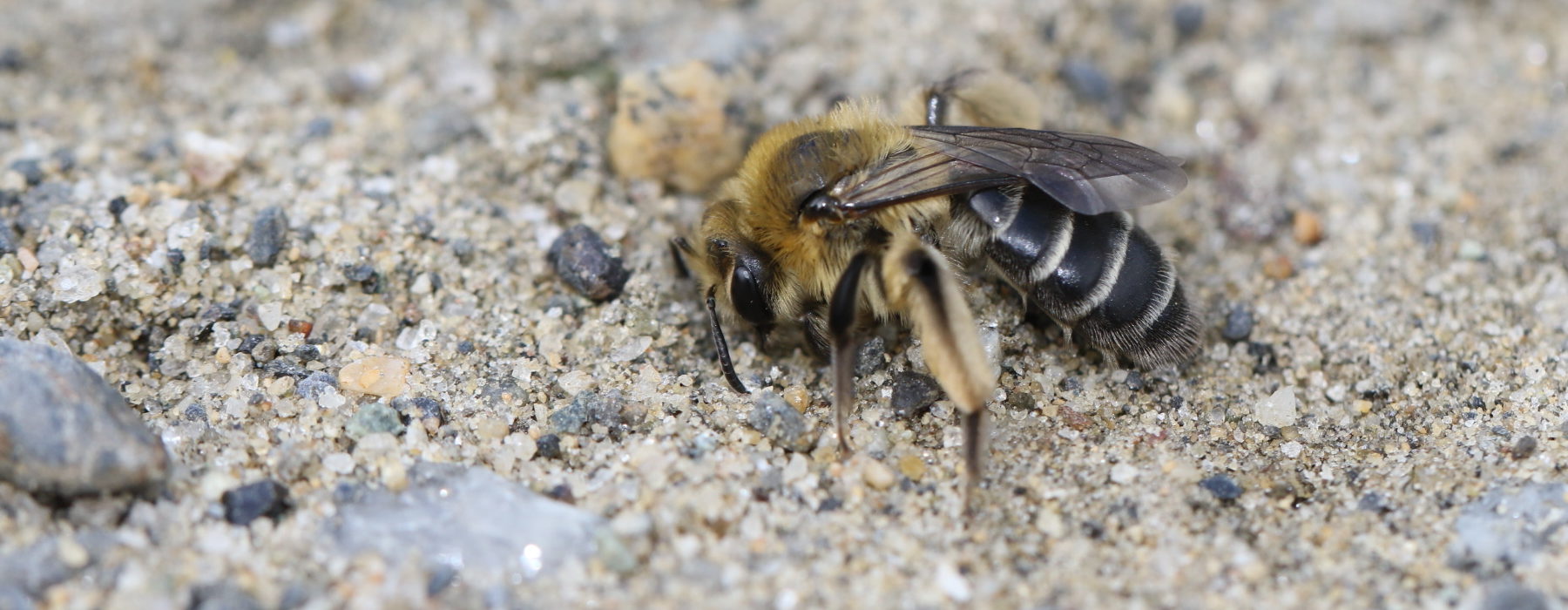
Vermont Bee Data
The Vermont Atlas of Life (VAL) makes biodiversity data avaiblable to the global community of researchers, educators, conservationists, students, and anyone else with an interest in our natural heritage. Bee occurrence records and datasets are freely available to explore and download. Please contact Spencer Hardy or Kent McFarland to obtain a copy of a study.
Our Publications
-
Hardy, S., Michael Veit, Joan Milan, John S. Ascher, Nathaniel Sharp, Michael T. Hallworth, Mark Ferguson, Leif Richardson, Charlie Nicholson, Taylor H. Ricketts, Jason Gibbs, and K.P. McFarland (2025). An Annotated Checklist of the Bees (Hymenoptera: Apoidea) of Vermont with Conservation Status and Natural History Notes. Northeastern Naturalist, Volume 32, Monograph 27: 1–73. https://doi.org/10.1656/045.032.m2701
- , , , , , , , and . 2024. Insect pollinators: The time is now for identifying species of greatest conservation need. Wildlife Society Bulletin e1537. https://doi.org/10.1002/wsb.1537
-
Hardy, Spencer, Michael T. Hallworth, Mark Ferguson, Nathaniel Sharp, Jason Loomis, Emily Anderson, K.P. McFarland. 2022. The State of Vermont’s Wild Bees 2022. https://stateofbees.vtatlasoflife.org/. Vermont Center for Ecostudies-Vermont Atlas of Life. https://doi.org/10.5281/zenodo.7261315
- McFarland, K.P. and L.L. Richardson. (2020). American Bumblebee (Bombus pensylvanicus): Report to the Vermont Endangered Species Committee. DOI:10.13140/RG.2.2.10826.29125
- Richardson, L.L., K.P. McFarland, S. Zahendra, and S. Hardy. 2018. Bumble bee (Bombus) distribution and diversity in Vermont, USA: a century of change. Journal of Insect Conservation. https://doi.org/10.1007/s10841-018-0113-5. (PDF)
- McFarland, K.P., L. Richardson, and S. Zahendra. 2014. Rusty-patched Bumble Bee (Bombus affinis): Report to the Vermont Endangered Species Committee. DOI: 10.13140/RG.2.1.1305.9289 (PDF)
- McFarland, K.P., L. Richardson, and S. Zahendra. 2014. Yellow-banded Bumblebee (Bombus terricola): Report to the Vermont Endangered Species Committee. DOI: 10.13140/RG.2.1.1764.0405.1844 (PDF)
- McFarland, K.P., L. Richardson, and S. Zahendra. 2014. Ashton’s Cuckoo Bumblebee (Bombus ashtoni): A report to the Vermont Endangered Species Committee. DOI: 10.13140/RG.2.1.2026.1844 (PDF)
Other Publications
This list of publications highlights ways in which VAL-mediated data are being used. VAL-mediated data include those from iNaturalist Vermont, which we directly use and support.
- Cornelisse, T., D.W. Inouye, R.E. Irwin, S. Jepsen, J.R. Mawdsley, M. Ormes, J. Daniels, D.M. Debinski, T. Griswold, J. Klymko, M.C. Orr, L. Richardson, N. Sears, D. Schweitzer, & B.E. Young (2025). Elevated extinction risk in over one-fifth of native North American pollinators, Proc. Natl. Acad. Sci. U.S.A. 122 (14) e2418742122, https://doi.org/10.1073/pnas.2418742122.
- (2025). Potential expanded pollinator distributions in North America under future climate. Ecological Solutions and Evidence, 6, e70025. https://doi.org/10.1002/2688-8319.70025
- Rousseau JS, Johnston A, Rodewald AD (2025) Where the wild bees are: Birds improve indicators of bee richness. PLoS ONE 20(4): e0321496. https://doi.org/10.1371/journal.pone.0321496
- Felix, F., Julia, L., Michael, O., Tingting, X., Shikun, G., Elia, G., … & Harald, M. (2024). Home-and-away comparisons of life history traits indicate enemy release and founder effects of the solitary bee, Megachile sculpturalis. Basic and Applied Ecology. https://doi.org/10.1016/j.baae.2024.02.008
- Guzman, L.M., Elle, E., Morandin, L.A. et al. Impact of pesticide use on wild bee distributions across the United States. Nat Sustain 7, 1324–1334 (2024). https://doi.org/10.1038/s41893-024-01413-8
- Hemberger, J., & Williams, N. M. (2024). Warming summer temperatures are rapidly restructuring North American bumble bee communities. Ecology Letters, 27(8), https://doi.org/10.1111/ele.14492
- Onuferko, T. M., & Rightmyer, M. G. (2024). A revision of the simplex species group of the cleptoparasitic bee genus Triepeolus Robertson, 1901 (Hymenoptera: Apidae). European Journal of Taxonomy, 950(1), 1–106. https://doi.org/10.5852/ejt.2024.950.2643
- Rousseau Josée S., Woodard S. Hollis, Jepsen Sarina, Du Clos Brianne, Johnston Alison, Danforth Bryan N., Rodewald Amanda D. (2024). Advancing bee conservation in the US: gaps and opportunities in data collection and reporting. Frontiers in Ecology and Evolution 12. https://www.frontiersin.org/articles/10.3389/fevo.2024.1346795
- Chesshire, P.R., Fischer, E.E., Dowdy, N.J., Griswold, T.L., Hughes, A.C., Orr, M.C., Ascher, J.S., Guzman, L.M., Hung, K.-L.J., Cobb, N.S. and McCabe, L.M. (2023), Completeness analysis for over 3000 United States bee species identifies persistent data gap. Ecography e06584. https://doi.org/10.1111/ecog.06584
- Chowdhury, S., Zalucki, M. P., Hanson, J. O., Tiatragul, S., Green, D., Watson, J. E., & Fuller, R. A. (2023). Three-quarters of insect species are insufficiently represented by protected areas. One Earth, 6(2), 139-146. https://doi.org/10.1016/j.oneear.2022.12.003 (pdf)
- Pope, N. S., Singh, A., Childers, A. K., Kapheim, K. M., Evans, J. D., & López-Uribe, M. M. (2023). The expansion of agriculture has shaped the recent evolutionary history of a specialized squash pollinator. Proceedings of the National Academy of Sciences, 120(15), e2208116120. https://doi.org/10.1073/pnas.2208116120
- Sheffield C, Palmier KM (2023) Range expansion of Bombus (Pyrobombus) bimaculatus Cresson in Canada (Hymenoptera, Apidae). Biodiversity Data Journal 11: e104657. https://doi.org/10.3897/BDJ.11.e104657
- Buckner, Mark A., and Bryan N. Danforth. 2022. “Climate-Driven Range Shifts of a Rare Specialist Bee, Macropis Nuda (Melittidae), and Its Host Plant, Lysimachia Ciliata (Primulaceae).” Global Ecology and Conservation, June, e02180. https://doi.org/10.1016/j.gecco.2022.e02180
- Dorian, N. N., McCarthy, M. W., & Crone, E. E. (2022). Ecological traits explain long‐term phenological trends in solitary bees. Journal of Animal Ecology. https://doi.org/10.1111/1365-2656.13778
- Jackson, H. M., Johnson, S. A., Morandin, L. A., Richardson, L. L., Guzman, L. M., & M’Gonigle, L. K. (2022). Climate change winners and losers among North American bumblebees. Biology Letters, 18(6), 20210551. https://doi.org/10.1098/rsbl.2021.0551
- Lanner, J., Dubos, N., Geslin, B., Leroy, B., Hernández-Castellano, C., Dubaić, J. B., … & Meimberg, H. (2022). On the road: Anthropogenic factors drive the invasion risk of a wild solitary bee species. Science of The Total Environment, 154246. https://doi.org/10.1016/j.scitotenv.2022.154246
- Morgan E Christman, Lori R Spears, Jonathan B U Koch, Thuy-Tien T Lindsay, James P Strange, Cody L Barnes, Ricardo A Ramirez, Captive Rearing Success and Critical Thermal Maxima of Bombus griseocollis (Hymenoptera: Apidae): A Candidate for Commercialization?, Journal of Insect Science, Volume 22, Issue 6, November 2022, 2, https://doi.org/10.1093/jisesa/ieac064
- & (2022) Pollen specialisation is associated with later phenology in Osmia bees (Hymenoptera: Megachilidae). Ecological Entomology, 1– 10. https://doi.org/10.1111/een.13211
- Carril, O. M., & Wilson, J. S. (2021). Common Bees of Eastern North America (Vol. 151). Princeton University Press.
- Zattara, E. E., & Aizen, M. A. (2021). Worldwide occurrence records suggest a global decline in bee species richness. One Earth, 4(1), 114-123. https://doi.org/10.1016/j.oneear.2020.12.005
- Orr, Michael C., Alice C. Hughes, Douglas Chesters, John Pickering, Chao-Dong Zhu, John S. Ascher (2020). Global Patterns and Drivers of Bee Distribution. Current Biology. DOI: https://doi.org/10.1016/j.cub.2020.10.053.