Summary
- Natural history: A habitat specialist confined to high-elevation balsam fir forest, Bicknell’s Thrush was only recognized as a species distinct from the Gray-cheeked Thrush in 1995. Its apparent rise in atlas records mostly reflects increased survey effort after Mountain Birdwatch launched in 2001 rather than real population growth, since range-wide monitoring shows this globally rare songbird (fewer than 126,000 individuals) is actually declining across most of its core range.
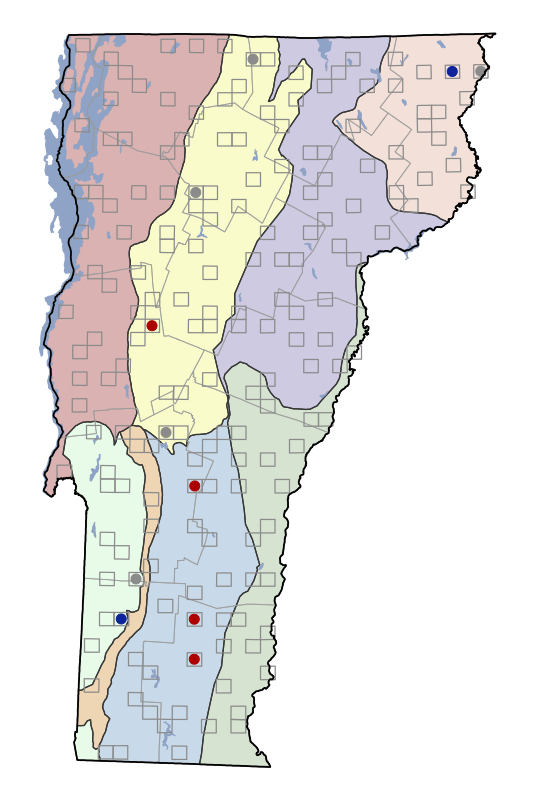
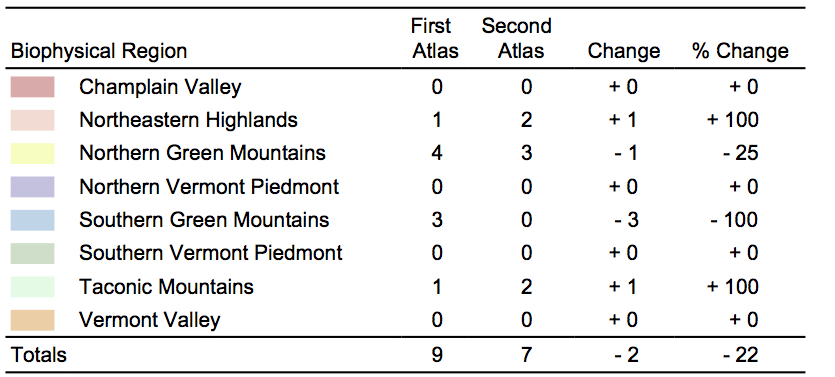
- Status in VT: Decreased by 22% (9 to 7 blocks). Greatest changes in Northeastern Highlands, Taconic Mountains (each +100%), and Southern Green Mountains (-100%). Increased by 167% in total records.
- Data from other research: MBW data indicate no statistical trend in Green Mountains.
- Conservation status: State rank S2B; SGCN-H; SSC
- Other atlases: NY: 46%
- VT’s role in North American range: VT is at the southern edge of the range.
- Causes of change since first Atlas: Minimal change in distribution; increase in records likely the result of increased attention upon designation as a distinct species and to Mountain Birdwatch monitoring.
- Management/Monitoring recommendations: See conservation action plan.
First Vermont Breeding Bird Atlas (1976-1981)
Second Vermont Breeding Bird Atlas (2003 – 2007)

Change in Distribution