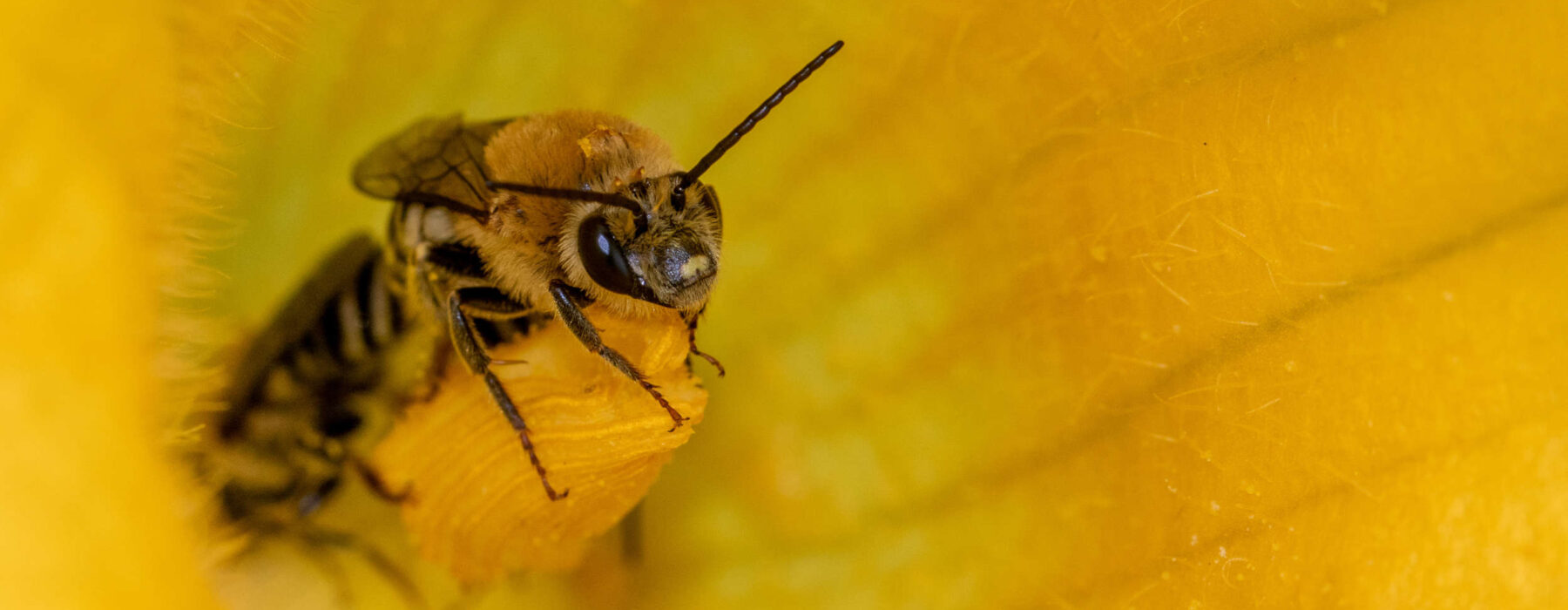
Wild bees are a diverse and ecologically important insect group. And as one of the most important groups of pollinators, they provide essential ecological and agricultural services.
Documented declines of a few bee species have caused concern about a possible collapse of all bee populations. But the last checklist of bee species found in Vermont was published more than 60 years ago, and included only 98 species of bees, with little to no information on their abundance or geographic distribution. The Vermont Wild Bee Survey represents the first step in assessing bee populations across the state, helping us deepen our understanding of the conservation status, threats, and the natural history of wild bees in our state.
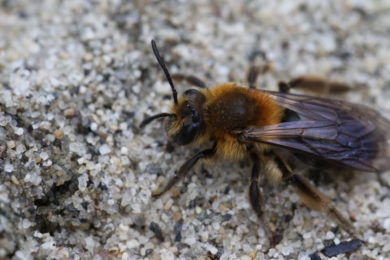
Female Dunning’s Mining Bee (Andrena dunningi ) © Spencer Hardy
The First Results of This Survey Are In
We published a decade-long study in October 2025 in the journal Northeastern Naturalist revealing that 352 wild bee species call Vermont home, with 60% of those species likely in need of conservation action.
The study, in collaboration with the Vermont Fish & Wildlife Department (VFWD) and bee experts from across the continent, provides the first comprehensive faunal list and conservation assessment of Vermont’s wild bees.
Acquiring the bee records for this study was no small feat. For over a decade, with a corps of over 2,500 volunteer community scientists, we searched across the entire state. Additionally, we combed through historical museum and private collections containing thousands of specimens, carefully verifying the identification and digitizing each specimen. Altogether, we amassed a database exceeding 79,000 individual encounters with wild bees from all of Vermont’s counties and biophysical regions, shared as open access data right here at the Vermont Atlas of Life .
Nearly half of the 352 bee species and a quarter of the over 79,000 bee-occurrence records submitted through 2023 came from community scientists. Some observations uploaded by community scientists to iNaturalist were remarkable, including a male Ground Cherry Sweat Bee ( Lasioglossum pectinatum) , and the first state record of Mock-orange Scissor Bee ( Chelostoma philadelphi ).
The study discovered nine species previously unreported in New England, several species not regularly found elsewhere in New England, and as many as 24 novel host-parasite bee relationships. We also documented over 20,000 observation records of bee-plant interactions, with 225 bee species visiting at least 342 different plant genera in 92 families, underscoring wild bees’ crucial importance as pollinators.
Vermont now has the largest list of known bee fauna of the northern New England states, not far behind recent studies in Connecticut and Massachusetts. Furthermore, Vermont’s most populous county, Chittenden, where this work began, has the second highest species total for any county in New England!
You may contact the study’s authors Kent McFarland or Spencer Hardy to obtain a copy of the study.
Read about the project’s background, check out the interactive checklist, learn how to beewatch, and how to cultivate good bee habitat on your land.