New Butterfly Species Discovered for Vermont
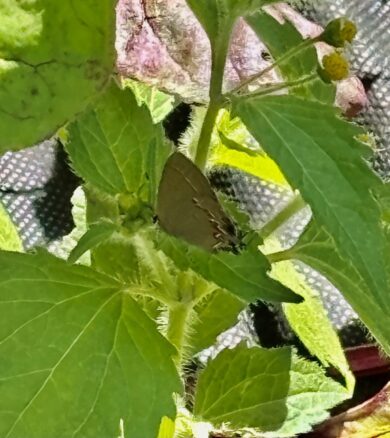
Vermont’s first record of a Red-banded Hairstreak found and photographed by Kevin Hemeon.
Kevin Hemeon, one of Vermont’s most fervent butterfly watchers, discovered a new butterfly for Vermont. He found a Red-banded Hairstreak (Calycopis cecrops) in Bennington while surveying butterflies for the Second Vermont Butterfly Atlas last week, the 120th species documented in the state.
“I flushed something small and low flying that went into the shade close to the ground. My first thought was a moth, but I took a closer look and saw the circular rubbing of the hind wings that Hairstreak butterflies do,” said Kevin.
Since it was late in the year, Kevin was thinking this might be something interesting, but he was leaning more towards the a more common Gray Hairstreak (Strymon melinus). “I always start with a quick photo so I at least get a shot that hopefully is an identifiable one,” said Kevin. “Then I go for progressively better images.” He captured that first safety image of the butterfly just as an onlooker came over to see what he was looking at, inadvertently flushing the butterfly into flight. Despite searching extensively, Kevin couldn’t find it again.
Finishing his survey, he went home still believing he likely observed a Gray Hairstreak. But when he got home and looked at the image, he realized he had something different. Computer vision agreed.
“I was surprised that AI identified it as either a White M Hairstreak or Red-banded Hairstreak, so sent it to the Vermont butterfly atlas group for help,” said Kevin.
Fellow Bennington County butterfly watcher, Terri Armata, went right to work. She enhanced the digital image by lightening the butterfly that was in the shade. It was suddenly clear to all, and the computer vision at e-Butterfly.org, Kevin had recorded a new butterfly species for Vermont.
Red-banded Hairstreaks have been creeping northward for sometime now and many of us were expecting it to be found in Vermont soon. Whether it can become established here one day as a breeder remains to be seen.
It is unique among the mostly more tropical species in the genus Calycopis in occupying more temperate areas. The caterpillars also seem to have a unique feeding strategy. Adults lay eggs on fallen leaves and the caterpillars feed on the detritus of Wax Myrtle (Myrica cerifera; not found in VT), Dwarf Sumac (Rhus copallina), Staghorn Sumac (R. typhina), and possibly several oaks. On Long Island, they are mostly found on Dward Sumac, which is found primarily in the Champlain and Connecticut River valleys.
This latest discovery brings the Vermont Butterfly Checklist count to 120 species of butterflies documented in the state.