Summary
- Natural history: Cattle Egrets are native to Africa, and after somehow spreading across the Atlantic on their own around the 1950s, they became one of the most successful bird colonizers of the modern era, unusual among herons for feeding in pastures alongside grazing cattle rather than in wetlands. Vermont’s small colony, first confirmed on Young Island in 1975, later shifted alongside its usual nesting companion, the Black-crowned Night-Heron, after Double-crested Cormorants killed off the nesting trees there in the early 1990s. Numbers here have fallen sharply since a peak of 22 nests in 1979, mirroring declines in New York and Ontario, and biologists now suspect Cattle Egrets could disappear entirely as a Vermont breeding species by the next atlas.
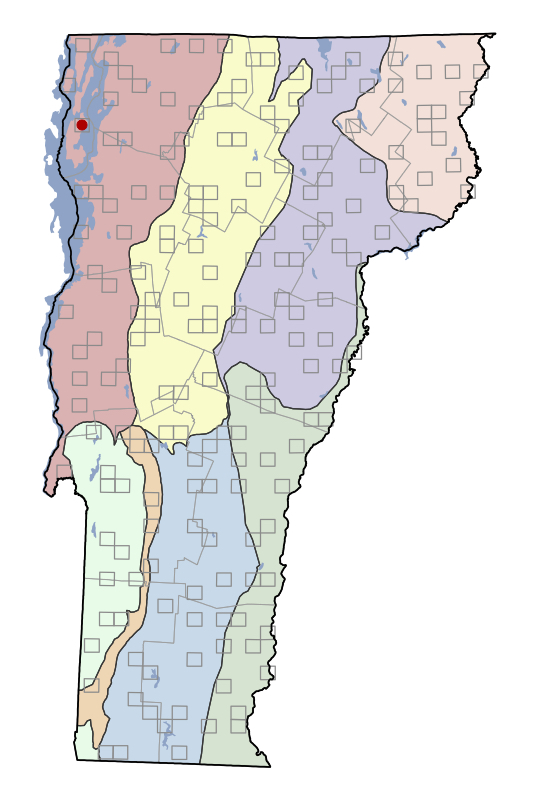
- Status in VT: Decreased by 100% (1 to 0 blocks). Decrease in Champlain Valley.
- Data from other research: No additional data for VT.
- Conservation status: State rank S1B
- Other atlases: NY: -65%; PA: -97%
- VT’s role in North American range: VT is at the northeastern edge of the range.
- Causes of change since first Atlas: Minimal change.
- Management/Monitoring recommendations:No current recommendations.
First Vermont Breeding Bird Atlas (1976-1981)
Second Vermont Breeding Bird Atlas (2003 – 2007)



Change in Distribution