Summary
- Natural history: Least Flycatchers have an unusual social streak for a flycatcher, often nesting in loose clusters where having other pairs nearby seems to matter almost as much to breeding success as habitat quality does. An 1884 account by the naturalist Cutting ranked it as Vermont’s most numerous flycatcher, fitting for an era when scattered woodlots and orchards, rather than continuous forest, covered much of the state. The species still occupies nearly every part of Vermont in both atlases, but Breeding Bird Survey routes reveal a real decline behind that stable map, one tied to maturing forests and heavier deer browsing thinning out the open woodland understory these birds need.
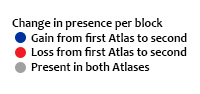
- Status in VT: Increased by 1% (171 to 172 blocks). Greatest increase in the Taconic Mountains.
- Data from other research: FMBP: annual decline of 9.5%
- Conservation status: State rank S5B
- Other atlases: NY: -4%; PA: -10%; MD: -10%; ON: little change
- VT’s role in North American range: VT is within the core of the range.
- Causes of change since first Atlas: Minimal change; woodland maturation and disturbance of forest structure by deer browsing could be problematic.
- Management/Monitoring recommendations: Monitor for future changes in response to rangewide declines revealed by BBS data.
Population Trends

First Vermont Breeding Bird Atlas (1976-1981)
Second Vermont Breeding Bird Atlas (2003 – 2007)


Change in Distribution