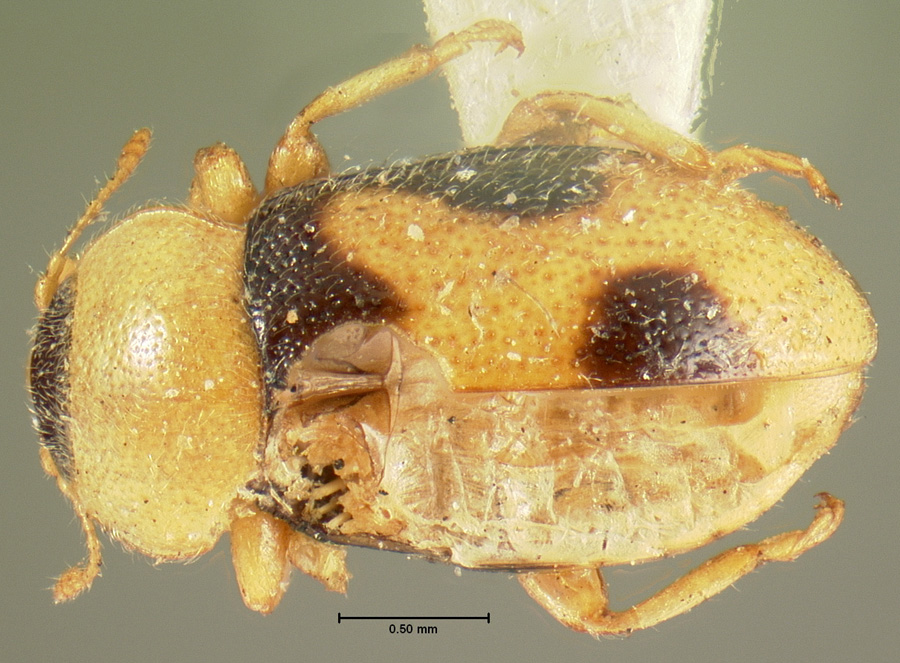
Lady Beetles weren’t on our radar until we unearthed a 50-year-old document – Lady Beetles: A Checklist of the Coccinellidae of Vermont in 2018. Within its pages, the authors noted the first and last date each Lady Beetle species was collected in Vermont and the total number of specimens known at the time.
Since at least the 1980s, native Lady Beetles that were once very common across the Northeast have become rare or have even gone missing. But there was little information readily available from Vermont. Spurred on by this old document, we began to assemble as much historic data as possible.
In 2020, I determined and digitized more than 800 specimens that were readily found in the Zadock Thompson Zoological Collections at the University of Vermont. A student curator quickly photographed each specimen with the information tag on the pin and sent them all to me. I was able to verify the identity, digitize the information from each label, and map the location where each was collected. I then added each record to the collection database and published them to the Global Biodiversity Information Facility (GBIF) for the Vermont Atlas of Life to use.
In the years that followed we added even more specimen records from collections across the state and started the Vermont Lady Beetle Atlas. With the help of hundreds of volunteers, we scoured the state for Lady Beetles, amassing thousands of records and data needed for us to understand the conservation status of these iconic beetles.
And then an amazing student intern appeared. Finn Flynn, a sophomore studying biology at UVM and a student in a museum internship course, led by Dr. Ellen Martinsen. Finn spent a semester searching through nearly 70,000 beetle specimens to determine which were from Haiti, which is now known to be the second largest collection of Haitian beetles, second only to Harvard University, and is unique in that no other museum contains this many specimens from the 1970s and 1980s.
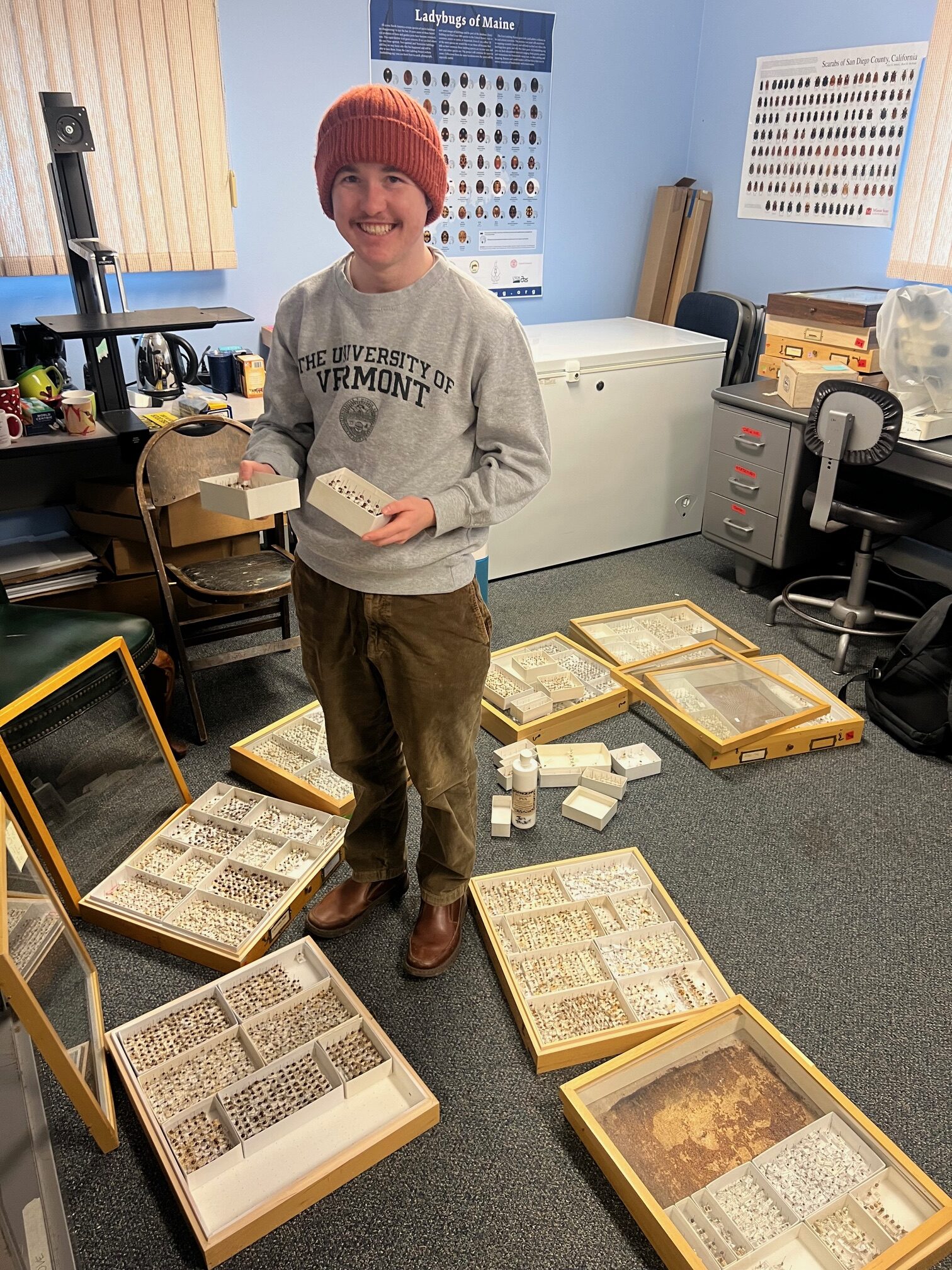
Finn Flynn working in the UVM collections.
Finn learned about our Lady Beetle work and knew that there were many more hidden in the collections. Ellen asked me if I’d be interested in co-hosting Finn as a summer intern so he could curate and digitize these remaining specimens. With an emphatic yes, Finn got to work. He thought perhaps there were another 500 or so specimens remaining to be examined and digitized.
Weeks later, Finn realized that was just the beginning. After scouring the collections he had amassed nearly 2,500 more specimens collected in Vermont. The oldest being from 1890, but the majority were collected from the 1960s to the 2000s, an incredibly valuable dataset that could help us understand changes to the Lady Beetle fauna and populations in the state.
With all of the historical collections digitized and several years of modern surveys complete, we found that 47 Lady Beetle species had been documented in Vermont. But one day in June Finn found some intriguing references to yet another species.
“Did you know that Coccidula lepida (Snow Lady Beetle) was (quite possibly?) first described in Vermont? I was also able to find multiple references that list Vermont as within its range,” wrote Finn. “As far as I know, there are no museum specimens of this species from Vermont located in the state, though interestingly some papers do refer to a Vermont type specimen. Where is that specimen housed?”
There didn’t seem to be any records for Vermont in GBIF and it appeared to have been rarely reported in the region at all. We really needed a specimen or a good photographic voucher to consider this species as part of the Vermont fauna. And then came an email message from Finn in September.
“Guess what I just found? Coccidula lepida from Burlington, Vermont in 1952,” wrote Finn.
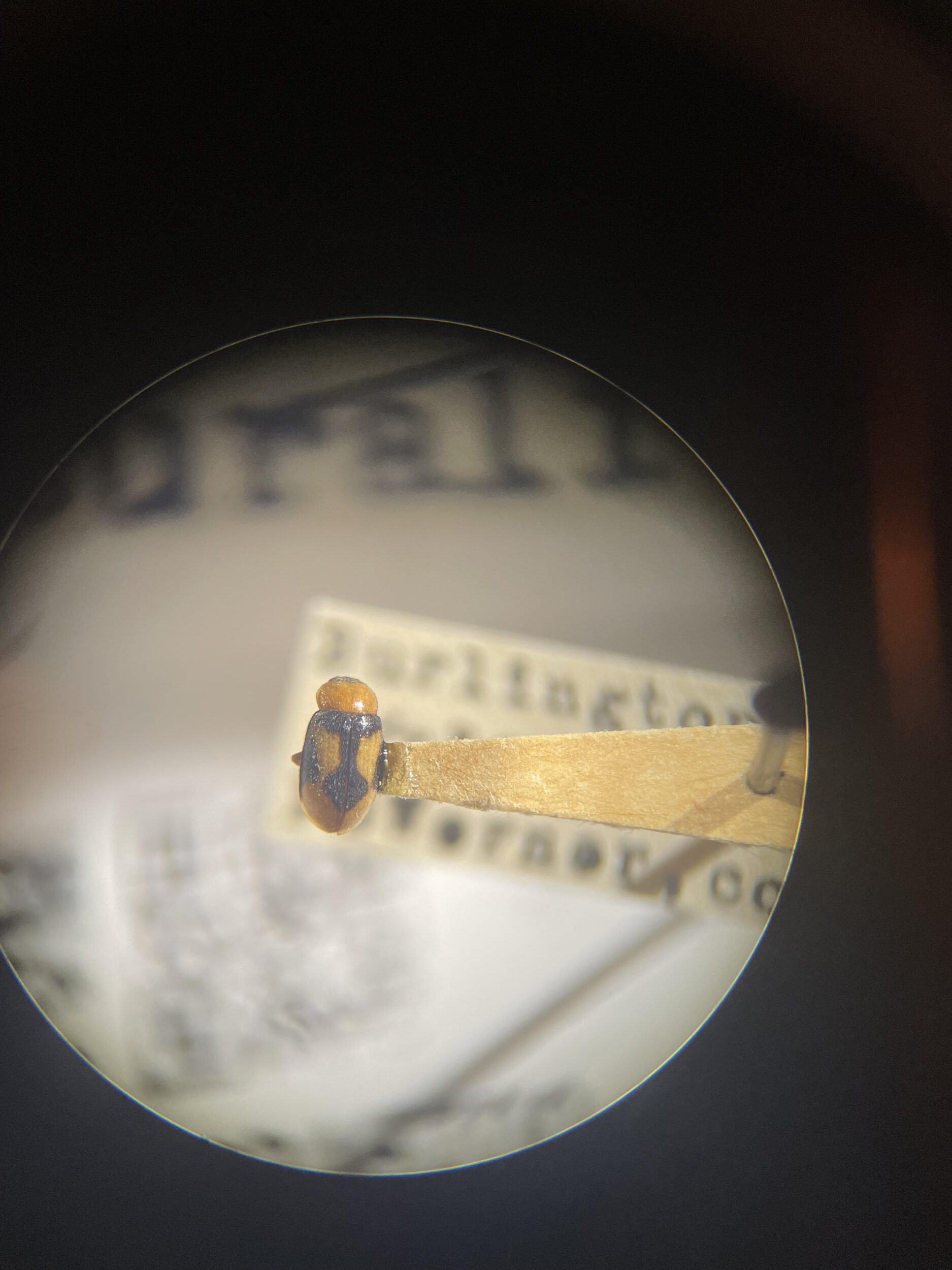
A 1952 Snow Lady Beetle specimen from Burlington, Vermont.
Was the type specimen (the original specimen used to describe and name the species) from Vermont as Finn suspected? With the field season over, I had to dig into this.
As Finn found, Leconte first described this species from “One specimen, Vermont. Prof. C.B. Adams” noted Leconte in his 1854 paper . I found that Charles Baker Adams was a professor at Middlebury College from 1838 to 1847, and also served as the Vermont State Geologist, so that checked out. Then, consulting Gordon (1985) The Coccinellidae (Coleoptera) of America North of Mexico, he noted that the type specimen was from Vermont and more importantly, it was found in the Harvard Museum of Comparative Zoology (MCZ). I was now hot on the trail!
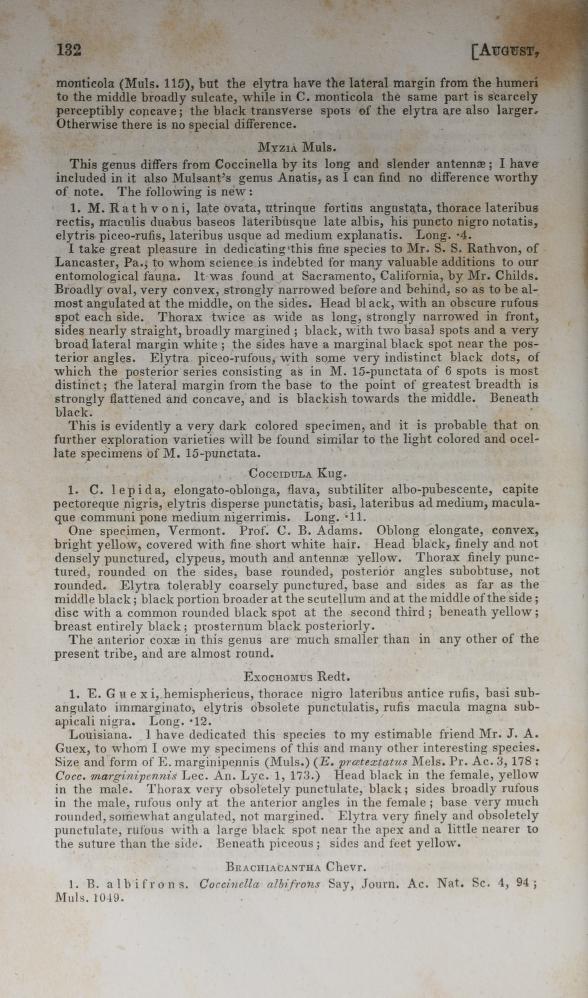
LeConte 1852, page 132. “One specimen, Vermont. Prof. C. B. Adams.”
I consulted the MCZ online database, which is also shared with GBIF, and found a specimen that seemed to fit, but it was listed as a mid-Atlantic location. This had to be it. I dashed off an email to Zoe Flores, Curatorial Assistant at the museum that was listed as working on this collection. She immediately got back to me.
After reviewing the specimen record, the original publication, and the available image of the disc, you are correct that this is the Vermont specimen collected by C. B. Adams; the inconsistency in the recorded locality (“Middle States”) appears to be a misclassification of the disc color. Unfortunately, LeConte used two very similarly colored pink discs for two different US regions; dirt built up on the surface and the degradation of color vibrancy on some of them over the past 150+ years makes the distinction even harder. Because this specimen’s disc is quite dirty, it was classified as a PINK disc (= Middle States – Maryland, Delaware, New York, New Jersey, Pennsylvania, Connecticut, Rhode Island) rather than a PALE PINK disc (= Vermont, New Hampshire, Massachusetts).
We now know that the first collection of this species in Vermont was this holotype specimen (the only specimen used to describe it for the first time) collected by Charles Baker Adams probably sometime between 1838-1847 and likely near Middlebury, and described by John Lawrence LeConte in 1852 and was in his collection that is now found at the MCZ. Vermont has a “new” addition to the faunal list of Lady Beetles brought to light after more than 150 years.
We now have 13 records for Vermont and a “new” species for us to learn more about as it has not been observed since 1966. The common name, Snow Lady Beetle, refers to its early emergence in spring, when snow may still be on the ground. Something for all of us to look forward to searching for next spring.