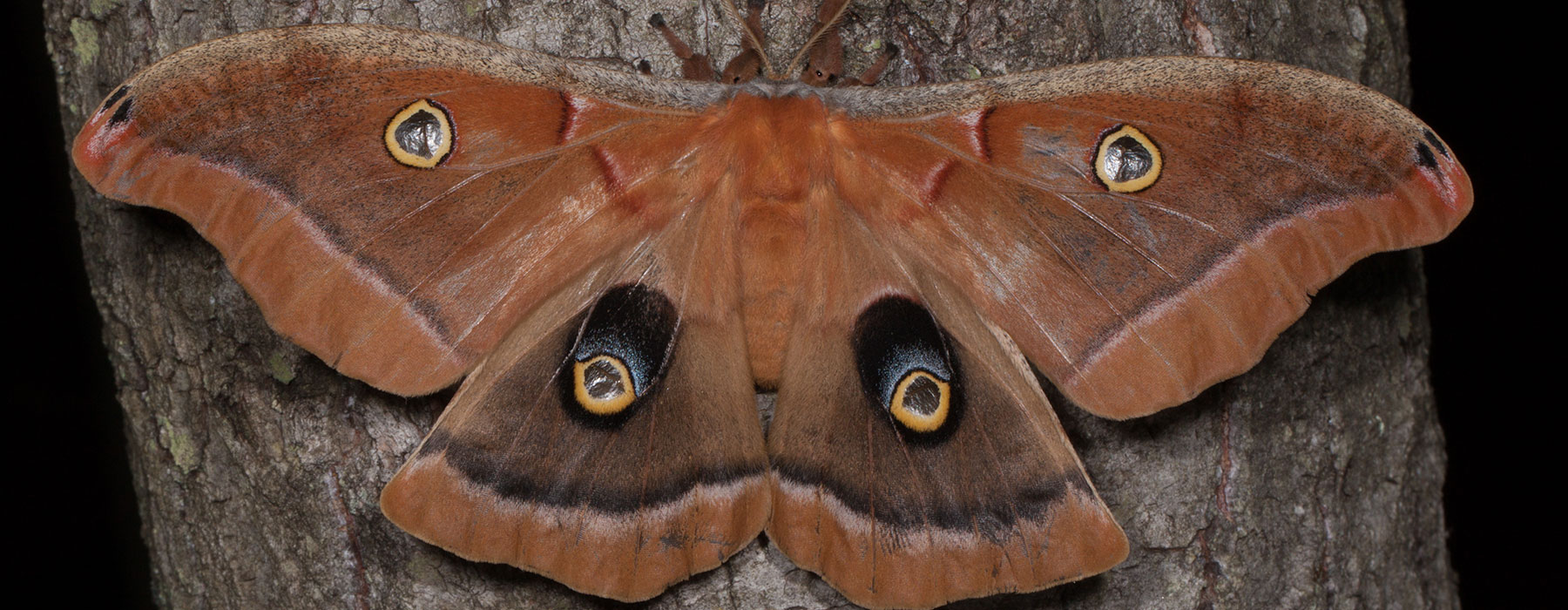
Maybe you’ve left your porch light on overnight and found dozens of moths hanging on your house in the morning. Or on a warm summer night, perhaps you’ve seen them streaking in and out of your car headlights.
Although many people overlook them, moths are abundant, widespread, and play vital roles in the ecosystem, affecting many other types of wildlife. Without moths, the dawn chorus of songbirds—which eat and feed their nestlings both adult moths and caterpillars—would nearly disappear from our forests. Night-flying adult moths form a major part of the diet of bats. And both adults and caterpillars are also food for other insects, spiders, frogs, and toads.
Here in Vermont we have recorded over 2,000 species of moths, and hundreds of those were first reported by people like you, who were curious enough to look a little closer, snap a photo, and report them to the Vermont Atlas of Life on iNaturalist. Thanks to the tireless efforts of both professional and amateur lepidopterists, since the 1995 landmark publication Moths and Butterflies of Vermont: A Faunal Checklist, we have discovered 346 new moth species in Vermont. There are likely more awaiting our discovery!
You can help our scientists research moths, too—no experience necessary!
National Moth Week (July 19–27) offers everyone everywhere a unique opportunity to become a community scientist. Each year we celebrate by encouraging moth watchers of all ages and abilities to learn about, observe, and document moths in backyards, parks, and anywhere else you encounter them. In doing so, you can help map moth species distribution and track their populations.
Just find a moth, snap a photo, and add it to the Vermont Moth Blitz 2025 project on iNaturalist. You don’t even need to know what kind of moth it is. The app’s computer vision is trained to identify many moths in Vermont, and will instantly help you with a preliminary identification. Experts across the region will check your observations and help confirm their identity.
Finding moths can be as simple as leaving a porch light on and checking it after dark. And while serious moth aficionados use special ultraviolet lights and fermented fruit bait to attract moths at night, day-flying moths can be observed visiting flowers in the sun. Check out this short introduction on how to start moth watching. It’s easy and fun!
Last year during National Moth Week, a Hops Angleshade (Niphonyx segregata) was photographed and shared to the Vermont Moth Blitz project and soon identified by taxonomic experts. It was believed to be introduced into the New York City area in the late 1990s from Asia. As the common name suggests, the caterpillars feed on Hops (Humulus spp.), a well-known plant to the home brewers among us. By the end of 2024, we had added 15 new moth species to the Vermont list.
Moth watchers like you have teamed together to record and share over 178,000 moth observations for more than 1,775 moth species across the state. This helps us understand their phenology (seasonal timing), habitat use, and range in Vermont.
To discover and share which moths are flying in your neighborhood during National Moth Week (July 19–27), join us for the 2025 Vermont Moth Blitz on iNaturalist.