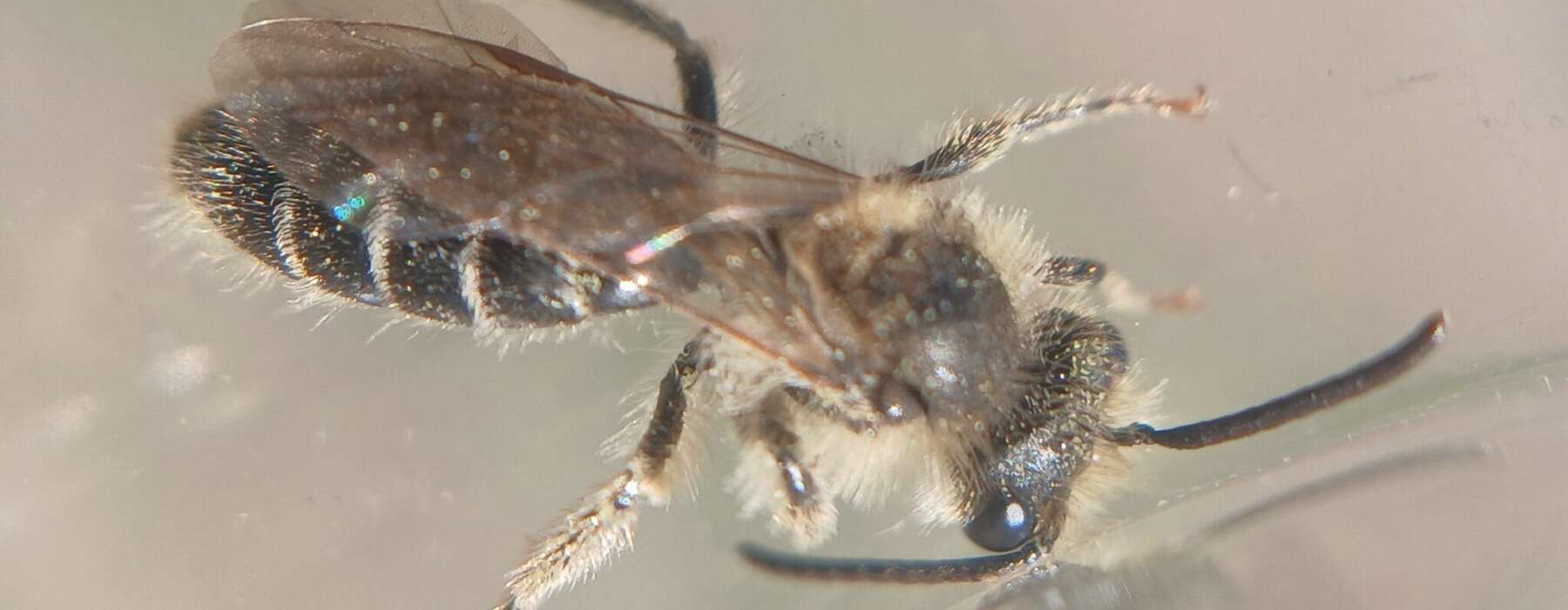
It has been in print for just six months, but our published checklist of Vermont’s bees is already out of date. In An Annotated Checklist of the Bees (Hymenoptera: Apoidea) of Vermont with Conservation Status and Natural History Notes we identified 19 species (out of 351 found in the state) that were known from historic records and remained lost despite our extensive field work. Now only 18 species are missing from the state.
On the first of May in 2024, VCE’s Julie Nicholson Community Science Awardee, Bernie Paquette, photographed more than 40 bees and uploaded them to iNaturalist Vermont, where Max McCarthy, a graduate student from New Jersey identified one of them as a member of the subgenus Parandrena, but there are two species in New England that aren’t readily distinguishable from photographs, and one of them, Sandbar Willow Miner (Andrena nida), was a lost species in Vermont.
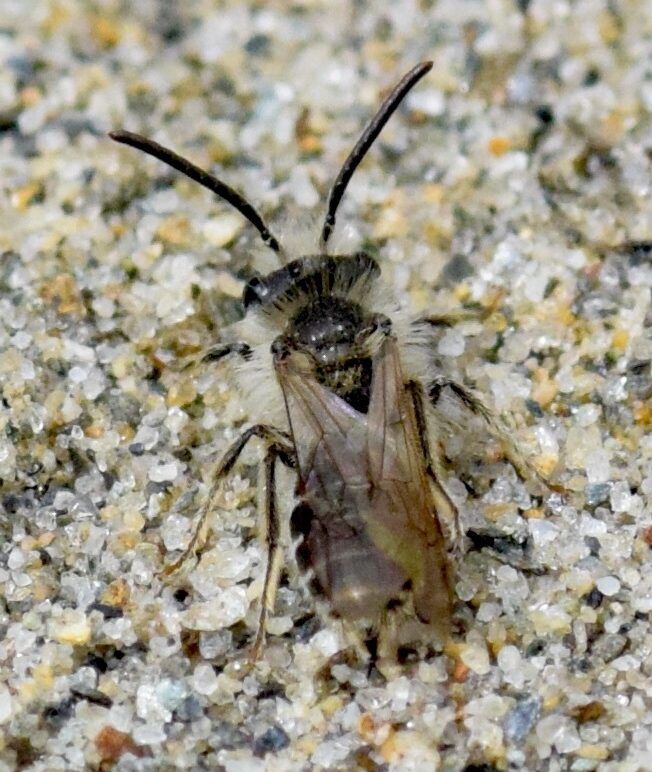
Bernie Paquette’s photograph from 2024 that led to the rediscovery of Andrena nida in Vermont. Note the two submarginal cells visible in the right wing (most other mining bees have three).
Fast forward to this past weekend with bee enthusiasts from across New England convening in Burlington for the Northeast Natural History Conference. During lunch, with warm weather and sun helping to tease us, a few of us decided to sneak out for the afternoon and try to re-find the bees that Bernie had photographed a short drive away. Just a few hours later, we’d found our target!
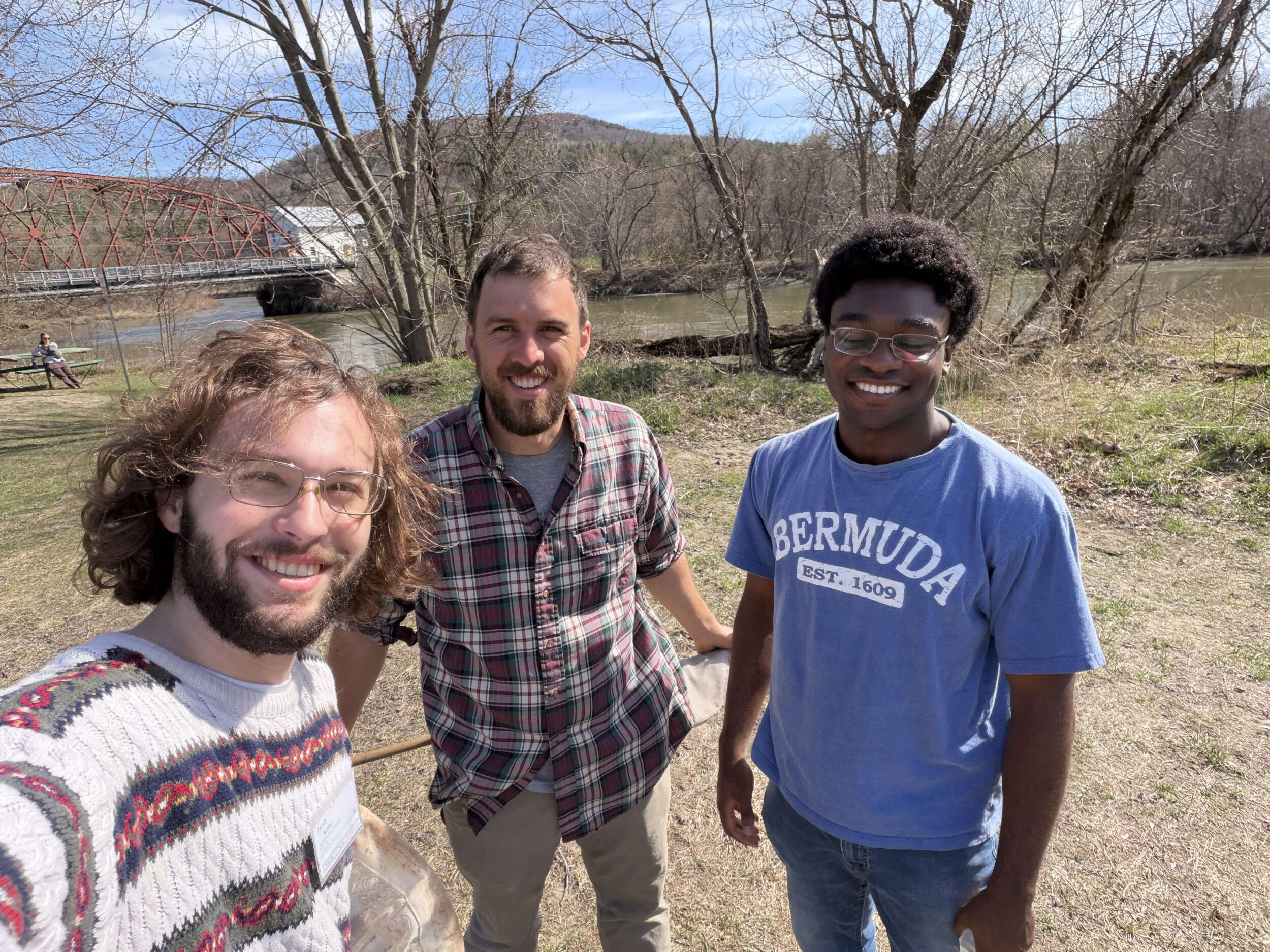
Jacob Keller, a graduate student in the Bee Lab at SUNY College of Environmental Science and Forestry, David Mantack from the Wild Bee Lab at the Connecticut Agricultural Experiment Station, and Spencer Hardy, VCE Bee Biologist searching for the elusive bee.
In a stroke of luck David Mantack, from the Wild Bee Lab at the Connecticut Agricultural Experiment Station, had recently seen Andrena nida in Connecticut and was well-versed in the characters needed to identify the species. The four of us, including Bernie and Jacob Keller, a graduate student in the Bee Lab at SUNY College of Environmental Science and Forestry, spent about an hour observing this species and several others around their nesting sites in a patch of sand deposited by the great flood of July 2023.
Regionally Andrena nida is poorly known, both Connecticut and Vermont had historical records (prior to 1972), but otherwise the species hadn’t been documented in New England until this spring. Why it hadn’t been found is a bit of a mystery, but from the recent records in the two states, combined with iNaturalist records reported farther south, we now know that the species flies very early in the season and likes to nest in fine, sandy substrate. It is thought to be a willow specialist, with the common name of Sandbar Willow Miner. This now appears to be a misnomer since its range and phenology doesn’t overlap much with Sandbar Willow (Salix interior) and a different mining bee, Maria’s Miner (Andrena mariae) appears to be closely associated with that willow species. All in all, a good reminder that science is never static and we still have lots to learn about the bee fauna of the state!