| Common Name | Franklin's Gull |
|---|---|
| Scientific Name | Leucophaeus pipixcan |
| Type of Report | Rare Species |
| Date of Observation | 05/21/2025 |
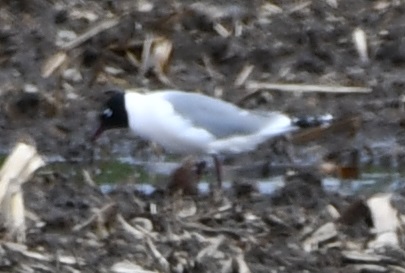
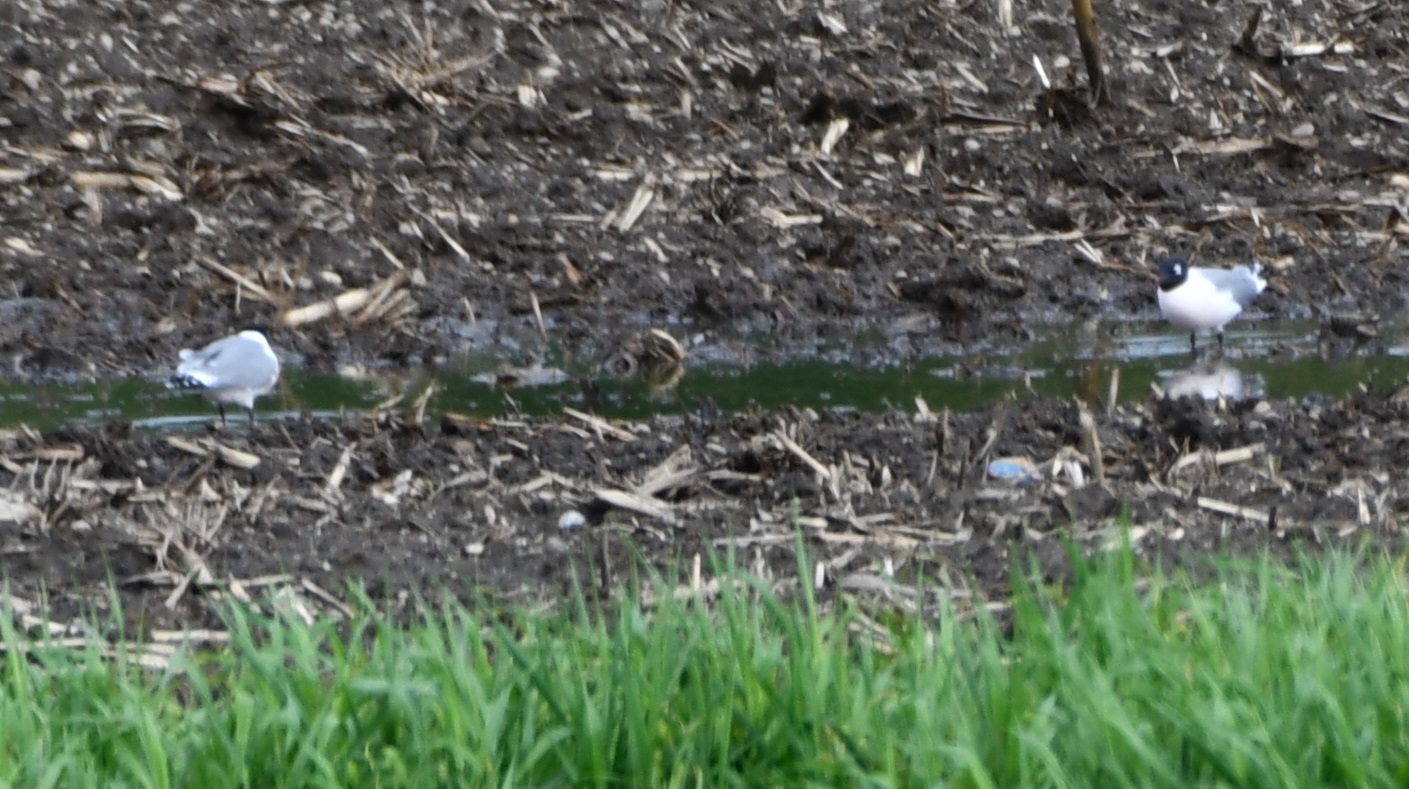
| Media | |
| Number Observed | 3 |
| Reporting Observer's Name | Tim Freiday |
| Mailing Address | 5409 Plot Road Johnson, VT 05656 United States Map It |
| Email hidden; Javascript is required. | |
| Date Completed | 05/24/2025 |
| Latitude of Observation (enter 0 if unable to provide) | 44.648535 |
| Longitude of Observation (enter 0 if unable to provide) | -72.893777 |
| Place Name | Boyden Farm |
| Township | Cambridge |
| County | Lamoille |
| Vermont eBird Checklist URL | ebird.org |
| Time of Day | 09:30 AM |
| Length of Time Observed | 15 minutes |
| Maximum Estimated Distance from Bird (in feet) | 450 |
| Minimum Estimated Distance from Bird (in feet) | 400 |
| Noteworthy Weather Conditions | Colder than usual with northwest winds meeting a northeast wind due to a storm swirling off the coast of Maine. Not raining at the time of the observation. |
| Optical Equipment Used for Observation | First observed at 8:45 AM with Leica 10x42 Ultravid Binoculars. I did not have my camera or scope at the time and sped back home to get my Nikon D7500 camera with 200-600 mm Nikkor lens to photograph |
| Observer’s Previous Acquaintance With This or Similar Species | I have seen many FRGU during my time living in TX and WY |
| I certify that any attachments included with this report were captured during this observation event. | |
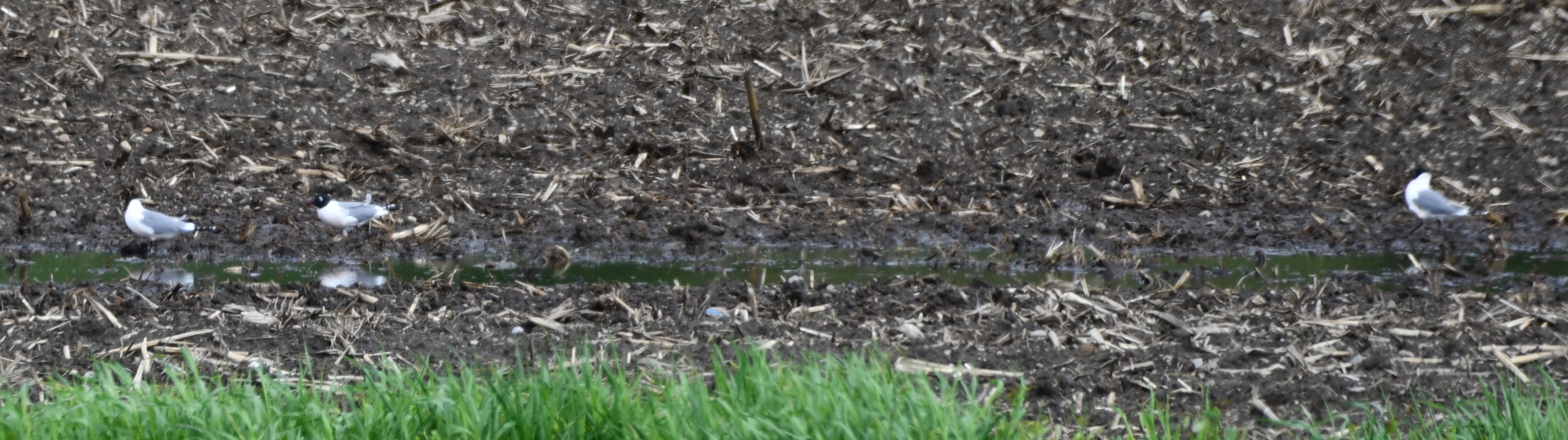
| Description of Habitat | The gulls were foraging near an area of open water in a muddy ag field that was recently plowed, near a grassy hedge. There were American crows foraging further out in the field, but the species were not intermingling. I heard a Canada goose in the vicinity as well. |
| Behaviors Observed | The gulls were walking and picking along the edge of the open water in the mud. They were often in close proximity to one another but did not have any aggressive interactions. The birds never flew for the duration of the observation. |
| Description of Vocalizations | None given |
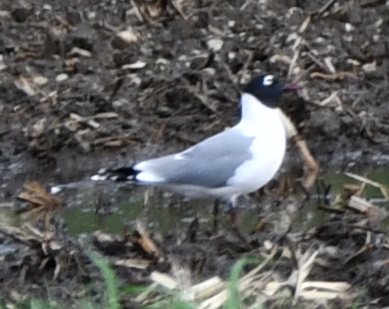
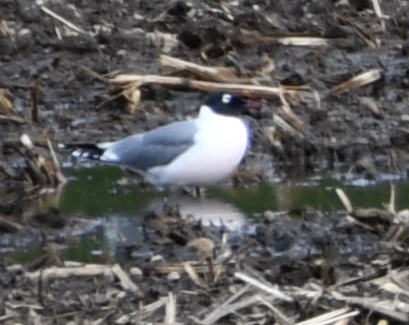
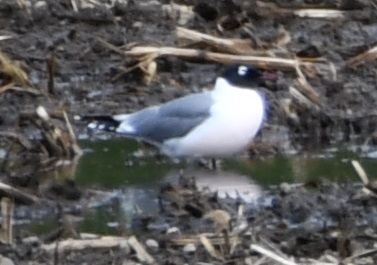
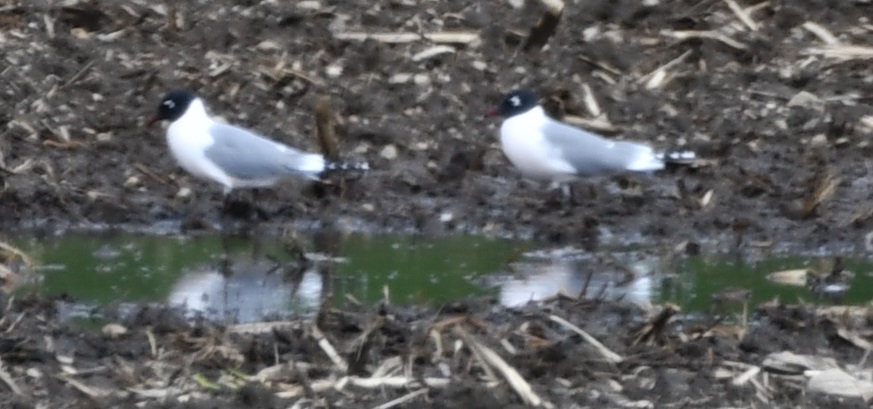
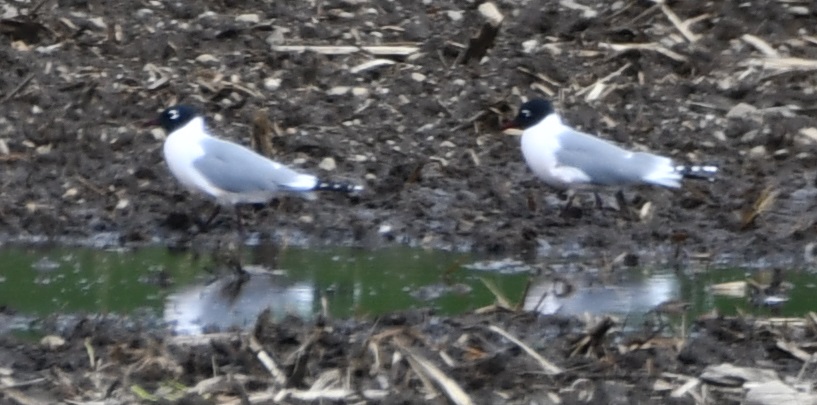
| Verbal Narrative & Description of Observation | I was driving to Fairfax to get some non-ethanol gas for the lawn mower when I noticed these three gulls in the field and pulled into a driveway to observe them. I noticed that they were hooded gulls with a light gray back, eye arcs, and white primary tips. The legs and bill appeared dark, and at that distance I couldn't get any color through binoculars. At the time of the observation I thought that they were Bonaparte's gulls due to the lighter colored mantle, as the Franklin's gulls I have seen have darker mantles more akin to the color of a laughing gull. I knew they were rare though, so I attempted to photograph them with my cell phone through my binoculars, unsuccessfully. I then sped back to my house to get my camera so I could properly photograph them. They were still in the same general area and I photographed them from the side of Route 104. Traffic was moderate and I was getting several horn blasts from disgruntled drivers (despite being fully off the traveled lane) so I did not spend much time observing them and I did not leave my vehicle for the duration of the observation. Even though I initially thought these gulls were BOGU due to the lighter mantle color and the fact that BOGU can show white eye arcs and white primary tips, the extent of the white around the eye and the amount of white on the primary tips were giving me pause. Nevertheless, due to the fact that the location was not a safe place to be I left after about 10 minutes of observation and maybe 20 photographs, of which many turned out to be blurry. When I drove back past the area around 10:20, the gulls were still there but I had to get back home to do some work so I didn't stop again. |
| Relative Size & Shape | Appeared small and dainty, although there were no other birds nearby so I could not get any relative size comparisons. Rounded head and short bills. |
| Head | Fully hooded gulls in breeding plumage, hood was truncated at the back of the neck. Extensive white eye arcs above and below the rear of the eye. |
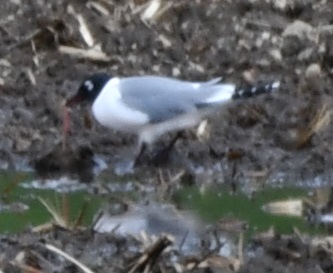
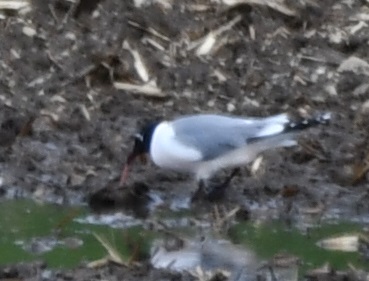
| Feet & Bill | Feet and bill appeared dark when viewed through binoculars. Bill was dainty, without a steep gonydeal angle. Bill color appears reddish in cropped photos, legs appear black. |
| Upper Back | Upper back was solid light gray, nape was white |
| Lower Back & Rump | Lower back was solid light gray, never got a look at the birds in flight but the rump appeared white |
| Wings | Wingtips extending beyond tail, extensive white spots on tips of the primaries, otherwise dark wingtips. White patch near the end of the wing. |
| Breast, Belly, Flanks, Under Tail Coverts | All appeared clean white. Maybe a hint of pink on the breast and belly visible from photographs but difficult to say |
| Tail | Only saw these birds walking on ground, but tail appeared white |
| IMPORTANT: What similar species were eliminated when making the identification and how was this bird different? | As previously stated, I initially thought these gulls were Bonaparte's gulls due to the light gray mantle and the fact that Bonaparte's gulls can show white eye arcs and primary tips as they are molting into breeding plumage. This would also be the expected hooded gull in the area, although it is getting late for them. The amount of white on the eye arcs and the size of the windows on the primaries were better for Franklin's gull, and the feature that really made me rethink the ID was the white patch at the end of the wings before the dark wingtips. Admittedly, this feature did not stand out to me in the field and it was only after reviewing photographs taken in the field and comparing them to photos of BOGU and FRGU on Macaulay library that I realized that this feature is absent from BOGU but present in both FRGU and LAGU. I ruled out laughing gull in the field due to the lighter gray mantle color and lack of a noticeable gonydeal angle. White eye arcs and primary tips would be less extensive in laughing gull as well. Hood appeared not to extend as far down the back as it would in LAGU. Little gull in breeding plumage would have white wing tips and no eye arcs. Black-headed gull would not show as extensive white eye arcs or primary windows, and would not have a white patch on the wing before the dark primaries. Sabine's gull would have a yellow bill tip. There are several other species of hooded gulls in the world that look very similar to Franklin's Gull, but none have a history of vagrancy. I consulted the bird of the world web page focused on gulls at this URL: https://carolinabirds.org/HTML/Gull.htm Andean Gull - high elevations in Peru Brown-headed gull - Asia Brown-hooded gull - South America Relict Gull - Asia Saunder's Gull - Asia |
| Other Notes & Comments | These were adults, unsure of sex. In looking at photos on Macaulay Library, it appears that Franklin's Gull can have lighter gray mantles like these birds and they are within the range of variation in plumage of the species although I have never personally seen a FRGU with a mantle that was that light gray. Notes were taken in the field but extensive research conducted after the sighting and details from memory and photographs are included in this write up. All photographs are unedited except for cropping. |
| This report was written from notes taken: | Written from Memory |
Vermont Atlas of Life Partners