| Common Name | Bullock's Oriole |
|---|---|
| Scientific Name | Icterus bullockii |
| Type of Report | Rare Species |
| Date of Observation | 12/04/2024 |
| Media | 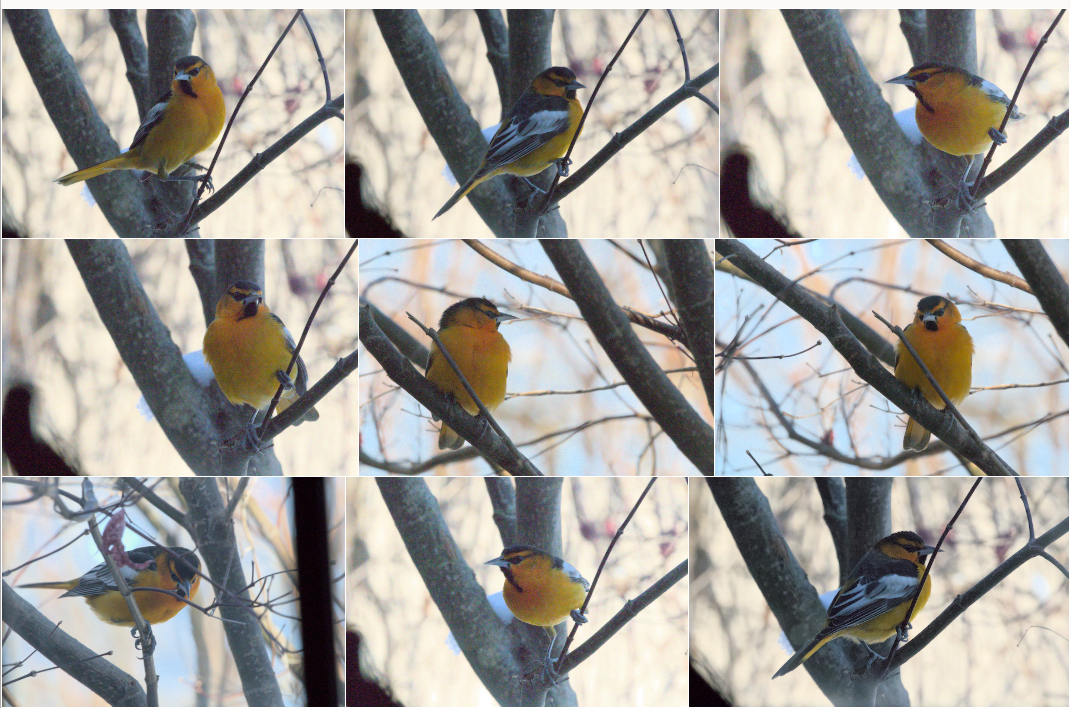 |
| Number Observed | 1 |
| Reporting Observer's Name | Chad Witko |
| Mailing Address | 106 Woodland Road Vernon, Vermont 05354 United States Map It |
| Email hidden; Javascript is required. | |
| Date Completed | 12/23/2024 |
| Names & Emails of Other Contributing Observers | Many other experienced birders were present at the time of the observation. |
| Latitude of Observation (enter 0 if unable to provide) | 42.858743 |
| Longitude of Observation (enter 0 if unable to provide) | -72.586482 |
| Place Name | 80 MacIntosh Lane |
| Township | Brattleboro |
| County | Windham |
| Vermont eBird Checklist URL | ebird.org |
| Time of Day | 08:45 AM |
| Length of Time Observed | 1 HOUR |
| Maximum Estimated Distance from Bird (in feet) | 50 feet |
| Minimum Estimated Distance from Bird (in feet) | 10 feet |
| Noteworthy Weather Conditions | Scattered clouds |
| Optical Equipment Used for Observation | Zeiss SFL 8x40. |
| Observer’s Previous Acquaintance With This or Similar Species | I've observed this species in the western parts of the United States. |
| I certify that any attachments included with this report were captured during this observation event. | |
| Description of Habitat | Suburban neighborhood/gardens. |
| Behaviors Observed | Flying strongly, the oriole was visiting a mealworm feeder placed in the front garden close to the home. Skittish at times, it would regularly visit during the time of observation. |
| Description of Vocalizations | Silent. |
| Verbal Narrative & Description of Observation | An orange and black oriole with large white wing patches coming to feed on a mealworm feeder in the homeowner's front garden. |
| Relative Size & Shape | Slim and sturdy icterid with a medium-long tail and sharply pointed bill. |
| Head | Orange-yellow head (superciliary stripe, auriculars, side of neck) with black crown, nape, chin, throat center. |
| Feet & Bill | Sharply pointed bill, gray. Feet and legs gray. |
| Upper Back | The upper back and scapulars were dark with lighter edges to the feathers. |
| Lower Back & Rump | Lower back and rump yellow-orange with dusky tones. |
| Wings | Remiges black/dusky, edged white. Large white wing panel (median and greater coverts) very evident, even at a distance. |
| Breast, Belly, Flanks, Under Tail Coverts | Underparts (breast, belly, flanks, under tail coverts) were bright yellow-orange. |
| Tail | The tail was medium-long for the size of a bird, with dark feathers through the center and yellow-orange outer tail feathers. |
| IMPORTANT: What similar species were eliminated when making the identification and how was this bird different? | Other orioles were considered (Baltimore, Hooded), but Bullock's is the only likely option due to all the added features (black eye line on an orange face, black throat, large white wing panel). Further, Bullock's Orioles have a propensity to show up as vagrants across the region. |
| Other Notes & Comments | Adult male. |
| This report was written from notes taken: | Immediately After |
Vermont Atlas of Life Partners