| Common Name | Hammond's Flycatcher |
|---|---|
| Scientific Name | Empidonax hammondii |
| Type of Report | Rare Species |
| Date of Observation | 11/19/2024 |
| Media | 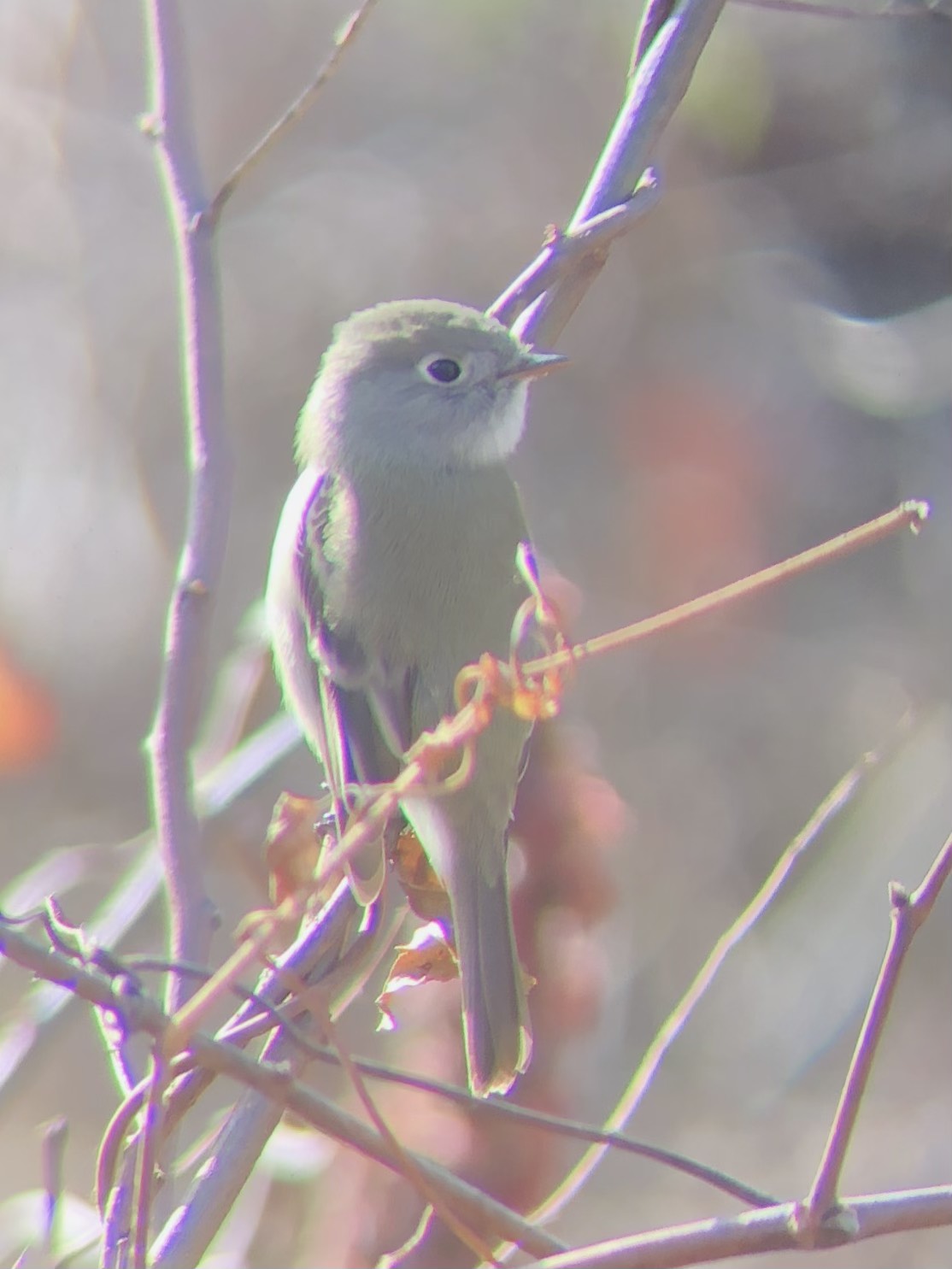 |
| Number Observed | 1 |
| Reporting Observer's Name | Ben Whittington |
| Mailing Address | 359 Minard Road Putney, Vermont 05346 United States Map It |
| Email hidden; Javascript is required. | |
| Date Completed | 11/25/2024 |
| Latitude of Observation (enter 0 if unable to provide) | 43.1245463452 |
| Longitude of Observation (enter 0 if unable to provide) | -72.535668046 |
| Place Name | Private Residence |
| Township | Westminster |
| County | Windham |
| Vermont eBird Checklist URL | ebird.org |
| Time of Day | 08:42 AM |
| Length of Time Observed | 20 |
| Maximum Estimated Distance from Bird (in feet) | 40 |
| Minimum Estimated Distance from Bird (in feet) | 7 |
| Optical Equipment Used for Observation | 8x binoculars, 20x-60x scope (on 20x) |
| Observer’s Previous Acquaintance With This or Similar Species | I have limited experience with this species, and have only seen one once before. |
| I certify that any attachments included with this report were captured during this observation event. | |
| Verbal Narrative & Description of Observation | I took the long way home from Westminster Center School, briefly stopping by Herrick's Cove & Albee's Cove. I was on the phone as I got out of the car but noticed a bird fluttering up off the grass and then back down somewhat in the manner of a phoebe. After pulling the bird in the binoculars, I recognized it as an empid, immediately hung up the call and pulled the scope from the back of the car. The bird flew to the east side of the house, and was sitting in the sumac very close to the deck. The initial pictures were digiscope pictures via the scope on the deck - approximately 20ft from the bird. My first impressions were: notable color contrast between its gray face and olive back & wings, low contrasting throat, and small bill. More so, I was focused on attempting to get decent photos, notifying local birders that could take better photos, and not losing the bird before others arrived. The bird was in and out of visibility until 9:25am and additional observers arrived at 9:35am. After nearly an hour of looking with other, the bird was fortunately refound just before 10:30am. |
| Head | Large, grayish head with slightly peaked crown. |
| Feet & Bill | Small bill. In my photos, the lower mandible appears relatively orange throughout which would not point to HAFL. However, other's photos, an hour later with actual cameras show a darker bill thus the orange mandible coloring in my photos are likely an artifact of the light and poor photography. |
| IMPORTANT: What similar species were eliminated when making the identification and how was this bird different? | Given the date, I would have studied any empid quite closely but first impressions were that this was not a Vermont breeding flycatcher. But to go through the typicals: Least: Most likely candidate given the bird's small size, and conspicuous eyering. The subject had minimal contrast on its throat, and long primaries. Alder/Willow: Subject had a very petite bill, and gray head/olive uppers. Easstern Wood Peewee: Structure and size. Subject had a large head, and was really tiny. Observed quite closely, at a location I'm very familiar with, so was able to judge size. Yellow bellied Flycatcher: Color, bill length My immediate suspicion was of a western flycatcher as the bird looked wrong for any eastern empids, and of the two most likely vagrants, Western or Hammond's, its coloration alone pointed away from Hammond's. However, I'd recently read an exchange on the Oregon listserv (from 4/23) between a reviewer of the recent flycatcher guide and the author where the notable gray head/olive back field mark was mentioned and I couldn't recall whether it was for Hammond's or both Hammond's & Dusky (incidentally, it was about Hammond's but deemed inconsistent by the author of the guide). After 10:30, when additional observers were able to view and photograph the bird, the consensus arose that the bird was a Hammod's Flycatcher. My review and subsequent study of the photos agrees with Hammond's. Small empid with conspicuous, messy eyering, long primaries with large gaping between primaries, low throat contrast, small bill, and notched tail. Additionally, Hammond's completes prebasic molt in late summer - explaining the why this bird looked so 'fresh'. Circling back to Dusky finally, the bird's bill was far too small. |
| Other Notes & Comments | I'm having some difficulty uploading photos to this site at the moment. I have other photos, including those attached to the ebird checklist, that I'm happy to share if needed. |
| This report was written from notes taken: | Immediately After |
Vermont Atlas of Life Partners