| Common Name | Mexican Violetear Hummingbird |
|---|---|
| Scientific Name | Colibri thalassinus |
| Type of Report | Rare Species |
| Date of Observation | 09/12/2024 |
| Media | |
| Number Observed | 1 |
| Reporting Observer's Name | Krista Larrow |
| Mailing Address | 3385 North St Montpelier, VT 05602 United States Map It |
| Email hidden; Javascript is required. | |
| Date Completed | 09/21/2024 |
| Names & Emails of Other Contributing Observers | Benton Larrow |
| Latitude of Observation (enter 0 if unable to provide) | 44.2712 N |
| Longitude of Observation (enter 0 if unable to provide) | 72.4871W |
| Place Name | Private home |
| Township | East Montpelier, Vermont |
| County | Washington |
| Time of Day | 07:00 AM |
| Length of Time Observed | 30 min. |
| Maximum Estimated Distance from Bird (in feet) | 10 ft |
| Minimum Estimated Distance from Bird (in feet) | 3 ft |
| Noteworthy Weather Conditions | Dawn and dusk (we were away during middle of day) |
| Optical Equipment Used for Observation | None |
| Observer’s Previous Acquaintance With This or Similar Species | We are only familiar with the Ruby -Throated Hummingbird |
| I certify that any attachments included with this report were captured during this observation event. | |
| Description of Habitat | Backyard surrounded by hardwood forest. |
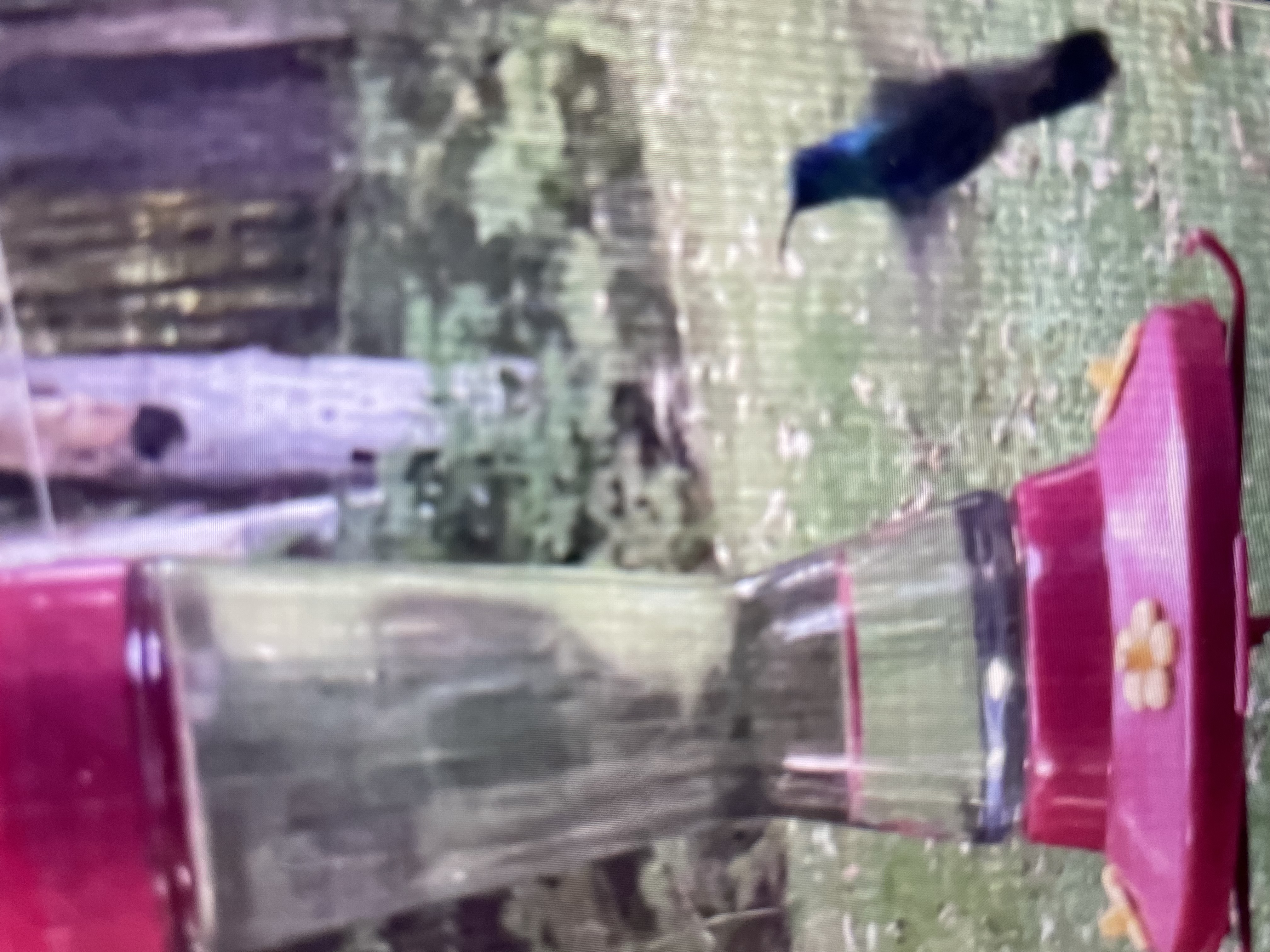
| Behaviors Observed | We observed the one bird at our two hummingbird feeders situated on opposite sides of our house. It would perch and feed at one of our feeders and only feed from the other. It would spend up to 1 minute or so at the feeders feeding and hoovering before flying off. It repeated feeding visits multiple times as we watched. We did not see where it would go between feedings, but we often could hear it vocalizing from a tree near by - squeaks and high-pitched chattering. I was able to take video through a window, 6 ft from one feeder, and also from inside my porch screen house no more than 3 ft away from the other feeder. |
| Description of Vocalizations | I believe it made some chipping vocalizations at the feeders as well as what seemed to be bill snapping noises. (Please turn up the volume on the attached video clips) We also heard high-pitched sqeaks and chatter from close-by trees between visits to the screen house feeder. |
| Verbal Narrative & Description of Observation | On the morning of September 12, just as it was becoming light outside (6:15-6:30 AM) we noticed a hummingbird at our deck feeder, but quickly agreed that it didn't look like a Ruby-Throated Hummingbird as it was too large and too dark in coloration. It made repeated visits to this feeder without perching. We then looked at our back feeder between front feeder visits and saw it feeding and perching there. We were unable to observe the feeders after 8:00 or so because of work etc. . We sent photos and video to local bird experts, Bridget Butler and Chip Darmstadt, for identification and information. We made similar observations in the early evening as dusk settled in. We were able to get close-up video (3 ft) from inside our screen house until it was too dark. The following morning (9/13/24), starting by 6:30 AM, we again were observing the bird at our feeders, this time with Chip Darmstadt present. He was able to photograph and get some video from a distance of 30 ft from the feeder. It made two longer visits with the two of us standing outside observing. Our last sighting was about 7:30 AM that morning. We watched until 8:30 or so before disbanding. We did not have any more sightings that evening or the next day - or since. |
| Relative Size & Shape | It had the typical slender hummingbird shape, but was noticeably larger than than the Ruby-Throated Hummingbird. It appeared to be about 4", fore-head to tip if tail, with a wingspan to 6" or so. |
| Head | The head was a dark iridescent blue/purple on the cheeks and seemed have some green on its face area. The throat area was green and matched the green of its main body. |
| Feet & Bill | We did not see its feet well enough to comment on them. The bill, as seen in our photos and video was dark and had a slight, but noticeable curve. |
| Upper Back | The way it was positioned at the feeders we did not get great looks at its back, it appeared to be iridescent green. |
| Lower Back & Rump | The lower back and rump areas appeared to be the same dark iridescent green or the same brownish/grayish color of the ends of its wings. |
| Wings | In flight the wings appeared to be a lighter gray/tan color, but that may be more of their underside color. Photos show that when it was perched at the feeder the shoulder wing feathers look dark green with a transition to a dark brown/grey towards the ends. There were not noticeable markings on the wings. |
| Breast, Belly, Flanks, Under Tail Coverts | The breast was the same iridescent green as its back and face. Its lower belly area shows to be a tan or beige. The underside of the tail looks to be a darker color, a dark gray. |
| Tail | The tails seemed to be the typical fan shape of a hummingbird. |
| IMPORTANT: What similar species were eliminated when making the identification and how was this bird different? | There are no similar species to compare it to. |
| Other Notes & Comments | We are assuming it was a single bird that we observed and that, because of its coloration, it was a male. |
| This report was written from notes taken: | Written from Memory |
Vermont Atlas of Life Partners