| Common Name | Dickcissel |
|---|---|
| Scientific Name | Spiza americana |
| Type of Report | Rare Nesting Species |
| Date of Observation | 07/23/2021 |
| Media | |
| Number Observed | 1 |
| Reporting Observer's Name | Alison Wagner |
| Mailing Address | P.O. Box 123 111 Highland Drive Huntington, vermont 05462 United States Map It |
| Email hidden; Javascript is required. | |
| Date Completed | 11/01/2021 |
| Latitude of Observation (enter 0 if unable to provide) | 0 |
| Longitude of Observation (enter 0 if unable to provide) | 0 |
| Place Name | Lagoon Road |
| Township | Hinesburg |
| County | Chittenden |
| Vermont eBird Checklist URL | ebird.org |
| Time of Day | 04:30 PM |
| Length of Time Observed | 15 minutes |
| Maximum Estimated Distance from Bird (in feet) | 50 feet |
| Minimum Estimated Distance from Bird (in feet) | 15 feet |
| Noteworthy Weather Conditions | Windy, sunny, and warm |
| Optical Equipment Used for Observation | Swarovski, 8.5 X42 and Kowa scope set at 20 power |
| Observer’s Previous Acquaintance With This or Similar Species | I had been observing a variety of behaviors of this species at this location since late June: male singing, pair engaged in copulation, pair carrying food to nest, removing fecal sacs, and likely behavior to encourage fledglings to leave nest (perched near nest for long periods of time and calling with food in beak vs. flying directly to nest). |
| I certify that any attachments included with this report were captured during this observation event. | |
| Description of Habitat | Large mowed and unmowed open fields. Bobolinks, Meadowlarks, Red-winged Blackbirds, killdeer, Wilson's Snipe, Eastern Kingbird, Swallows are some of the other species observed nesting here. |
| Behaviors Observed | First observed the Dickcissel perched on utility line, then it flew down and perched on tall vegetation. It remained there for at least 10 minutes, calling and looking around. |
| Description of Vocalizations | Only call notes heard, best described as soft, quick "chwip." It called constantly, looking around, for the entire 10 minutes I observed. |
| Verbal Narrative & Description of Observation | I had been walking Lagoon Road for two hours, in hopes of seeing evidence of a fledged Dickcissel. I returned to my car and was considering leaving when I noticed an Eastern Kingbird perched on the utility line. Further down the line, I noticed a different species perched and identified it as a Dickcissel before it flew across the road and perched on the top of tall vegetation. I was able to document it with photos and videos. I watched it for over ten minutes while it remained perched. It called incessantly, looking around in all directions. It swayed with the plant in the wind without losing its balance (unlike how a recently fledged bird that may toddle while perching on a windy day). |
| Relative Size & Shape | Noticeably smaller than Eastern Kingbird it was perched beside when first observed on the utility line. Similar in size and shape to HOSP. |
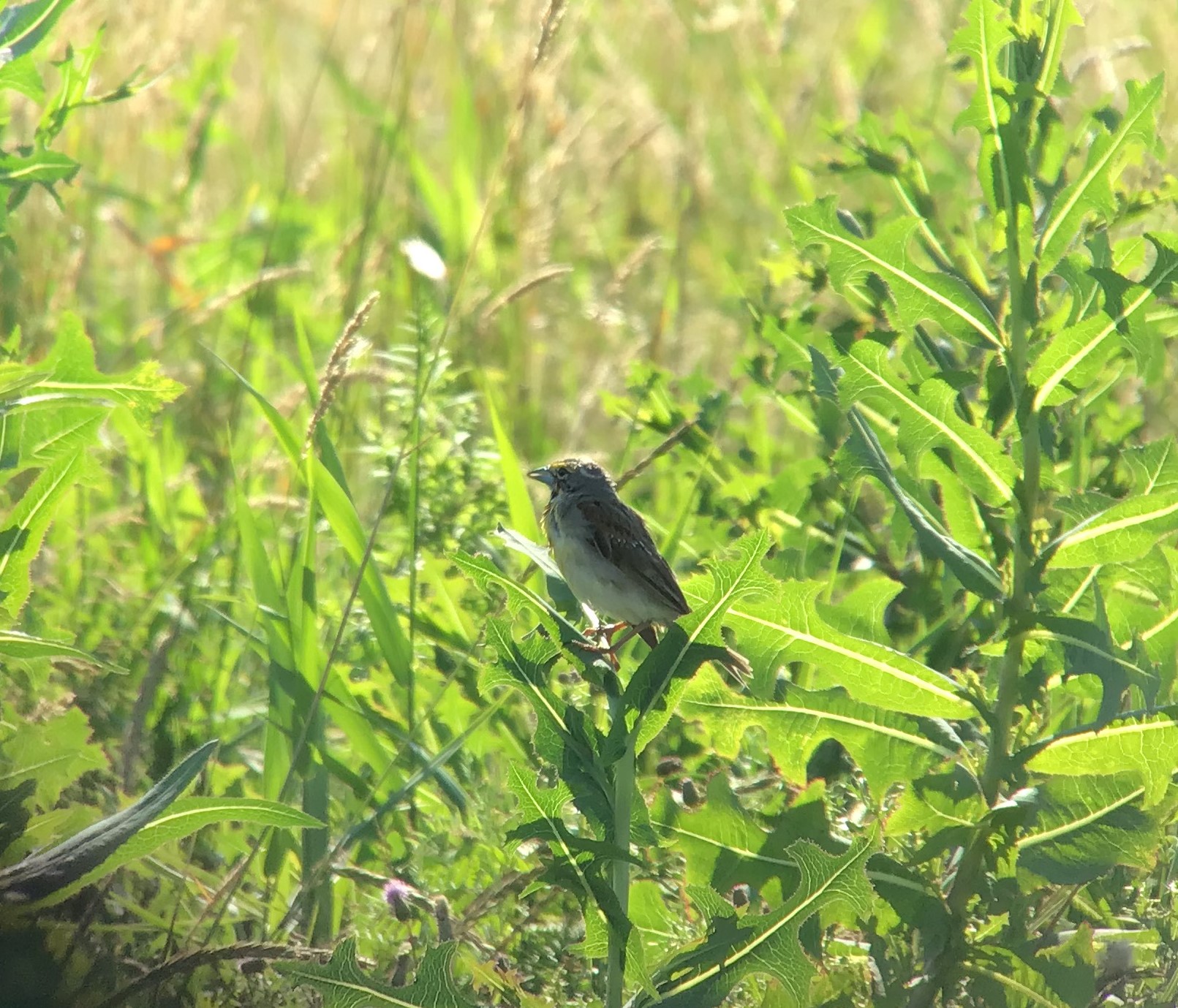
| Head | Light gray cap with some natal down still present; cheek and nape mostly gray with some brown at base of bill, malar area, and back of head. Long white/yellow supercillium and broken eyering. Light chin bordered with some dark feathering on throat. |
| Feet & Bill | Light gray chunky/conical bill. Feet and legs were light pinkish/yellow. |
| Upper Back | Upper back appeared gray with some brown streaking. |
| Lower Back & Rump | Lower back and rump was mostly gray with some brown. |
| Wings | Wings were unremarkable, gray and brown with no rufous showing. The wing covert feathers growing in uniformly stood out when I was observing with binoculars and then scope. |
| Breast, Belly, Flanks, Under Tail Coverts | Small amount of black seen on upper breast, bordering white chin. Breast had minimal, light yellow wash with some fine, dark streaking. Flanks were light gray. Belly and under tail coverts were white. |
| Tail | Gray brown tail of medium length. |
| IMPORTANT: What similar species were eliminated when making the identification and how was this bird different? | I ruled out adult Dickcissel by the few feathers of natal down on its head which is visible in videos. A molting adult would not have natal down. Also, the wing coverts show pin feathers growing in uniformly, and not staggered as would be the case with a molting adult. This bird looked very "fresh" overall. |
| Other Notes & Comments | I have also recorded an ethnogram over two days I observed the adult Dickcissels tending their young at this location on July 11 & 13. On July 11, observed for 75 minutes, the adults made 5 visits directly to the nest area. Then on July 13, observed for 72 |
| This report was written from notes taken: | During the Observation |
Vermont Atlas of Life Partners