| Common Name | Dickcissel |
|---|---|
| Scientific Name | Spiza americana |
| Type of Report | Rare Species |
| Date of Observation | 06/14/2021 |
| Media | 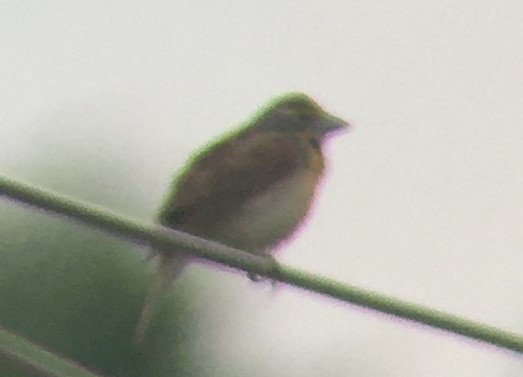 |
| Number Observed | 1 |
| Reporting Observer's Name | Bruce MacPherson |
| Mailing Address | 37 elsom parkway south burlington, VT 05403 United States Map It |
| Email hidden; Javascript is required. | |
| Date Completed | 07/02/2021 |
| Latitude of Observation (enter 0 if unable to provide) | 0 |
| Longitude of Observation (enter 0 if unable to provide) | 0 |
| Place Name | Lagoon Road |
| Township | Hinesburg |
| County | Chitenden |
| Vermont eBird Checklist URL | ebird.org |
| Time of Day | 02:30 PM |
| Length of Time Observed | 30 minutes |
| Maximum Estimated Distance from Bird (in feet) | 100 |
| Minimum Estimated Distance from Bird (in feet) | 100 |
| Noteworthy Weather Conditions | Cloudy; no wind; mid-70 degrees F. Good light. |
| Optical Equipment Used for Observation | Zeiss Terra ED binoculars 8 x 42 mm. Vanguard spotting scope 25-60 X. |
| Observer’s Previous Acquaintance With This or Similar Species | New species for me. |
| I certify that any attachments included with this report were captured during this observation event. | |
| Description of Habitat | Scrubby field previously used to grow cannabis now overgrown. |
| Behaviors Observed | This bird was singing from a powerline above the field. |
| Description of Vocalizations | I did not get close enough to this bird to hear its vocalization, but on subsequent occasions I have seen this bird again and heard its buzzy "dick-dick-cissel" song. |
| Verbal Narrative & Description of Observation | I observed this bird through binoculars and a spotting scope. I judged that it was grosbeak-like morphologically with a gray bill reminiscent in size and shape of a cardinal's beak. Prominent morphological features included a gray head with a well-defined yellow-white eyeline, rusty shoulders, a yellow breast with a black bib, and white underparts. |
| Relative Size & Shape | Roughly cardinal-size. |
| Head | Gray rounded head; well-defined eyeline variably yellow and white; prominent gray beak as noted. |
| Feet & Bill | Gray bill shaped like that of a cardinal or grosbeak. |
| Upper Back | Rusty shoulders when seen in good light. |
| Lower Back & Rump | Dark brown. |
| Wings | Yes. |
| Breast, Belly, Flanks, Under Tail Coverts | Yellow breast with a black bib. White underparts. |
| Tail | Relatively short tail; dark-colored; otherwise no distinct markings. |
| IMPORTANT: What similar species were eliminated when making the identification and how was this bird different? | At first glance I thought this bird might be a meadowlark based on the striking yellow breast and black bib. when I examined the bird closely, though, the beak, the head shape and markings, etc., were all wrong for meadowlark. Indeed I realized that I had never encountered this species before. Based on the shape of the bill and overall size and shape of the bird I thought it was likely to be in the same family as cardinals or grosbeaks. When I consulted Kaufman's field guide the photo of the adult male Dickcissel matched this bird perfectly. |
| Other Notes & Comments | Since I reported this bird in mid-June it has been observed by dozens of other birders who have taken photographs that are of much better quality than mine. Subsequently a female Dickcissel has been reported at this location by Alison Wagner, who has submitted her own RSD report. I have observed this female, as well as the male since her VT eBird report. |
| This report was written from notes taken: | Written from Memory |
Vermont Atlas of Life Partners