| Common Name | Dickcissel |
|---|---|
| Scientific Name | Spiza Americana |
| Type of Report | Rare Nesting Species |
| Date of Observation | 06/24/2021 |
| Media | |
| Number Observed | 2 |
| Reporting Observer's Name | Alison Wagner |
| Mailing Address | P.O. Box 123 111 Highland Drive Huntington, vermont 05462 United States Map It |
| Email hidden; Javascript is required. | |
| Date Completed | 06/30/2021 |
| Names & Emails of Other Contributing Observers | None, however several people have reported this pair of Dickcissels since I observed the female and have documented her in eBird with photographs. |
| Latitude of Observation (enter 0 if unable to provide) | 0 |
| Longitude of Observation (enter 0 if unable to provide) | 0 |
| Place Name | Lagoon Road |
| Township | Hinesburg |
| County | Chittenden |
| Vermont eBird Checklist URL | ebird.org |
| Time of Day | 06:30 AM |
| Length of Time Observed | 5 minutes |
| Maximum Estimated Distance from Bird (in feet) | 12 feet |
| Minimum Estimated Distance from Bird (in feet) | 8 feet |
| Noteworthy Weather Conditions | Calm winds, clear skies. |
| Optical Equipment Used for Observation | Swarovski 8.5 X 42 |
| Observer’s Previous Acquaintance With This or Similar Species | I had spent the past week observing many Dickcissels while on a cross country trip through states where this bird breeds. |
| I certify that any attachments included with this report were captured during this observation event. | |
| Description of Habitat | Lagoon Road intersects a very large flood plain. On the west side, are fallow fields. On the east side, some parts of the field are uncut while other parts are currently being farmed and were recently cut. Along both edges of the road are dense weedy vegetation. Bobolinks and Eastern Meadowlarks nest here as well as Snipe, geese, Killdeer, swallows, blackbird species, Savannah and Song Sparrows. |
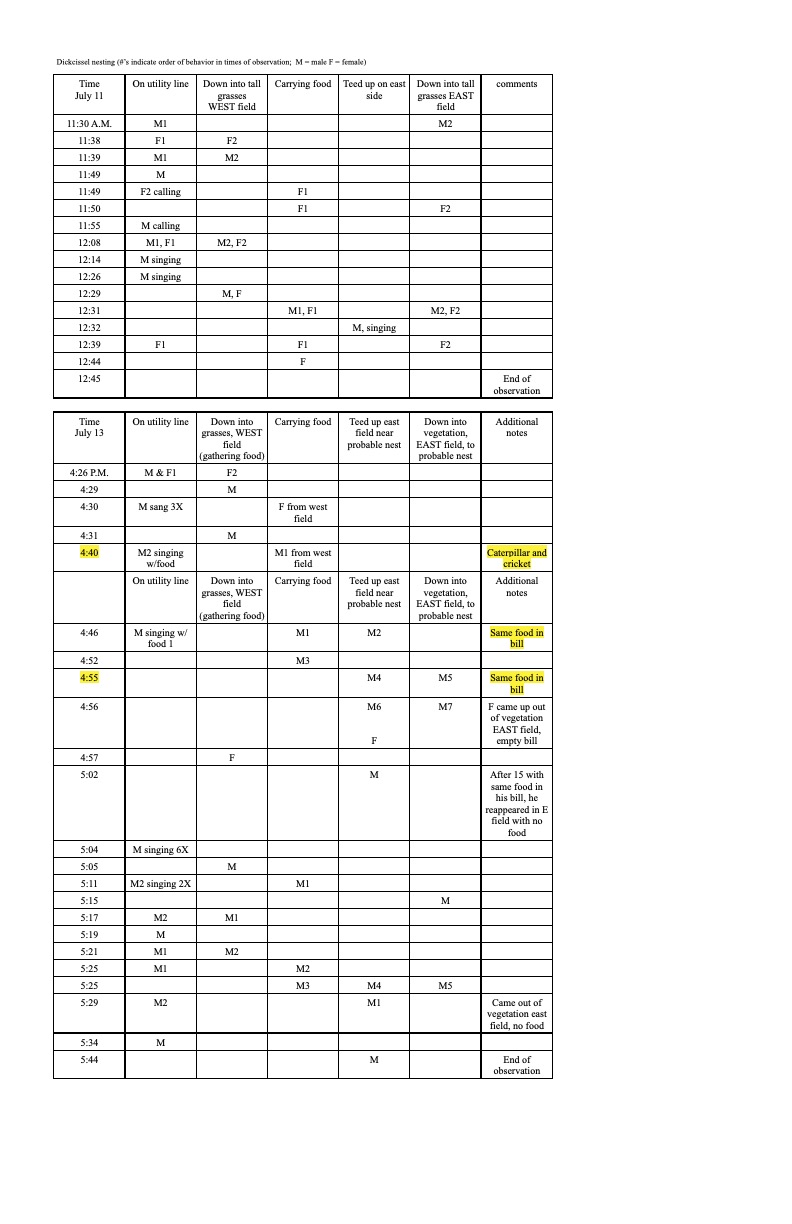
| Behaviors Observed | Female was perched on utility line the entire five minutes. The male was first hidden in tall weeds and singing, then flew up to the female and they copulated. Then the male then flew back down into the vegetation while the female remained on the line. |
| Description of Vocalizations | Male: a series of short buzzy notes (see eBird entry) |
| Verbal Narrative & Description of Observation | I drove down Lagoon Road slowly with the windows down to listen for the singing male. About a quarter of the way down the road, I heard it and stopped the car. I noticed a bird on the utility line very close to me, that I thought might be a Dickcissel, based on its size and shape, but it was not singing and it was duller than what I'd expect in a breeding male. |
| Relative Size & Shape | The size and shape of the bird(s) are similar to a sparrow (Song, not Savannah) |
| Head | Female: She had a brownish crown and cheek, large light (white and some yellow), light malar and throat with a very thin and dark malar stripe. |
| Feet & Bill | I did not observe feet. Bills on both birds were chunky like a grosbeak only longer, and light in color. |
| Upper Back | I did not observe their backs. Her nape was brownish. |
| Wings | Wings were sparrow like in color and streaking. |
| Breast, Belly, Flanks, Under Tail Coverts | Female: Her breast had a slight yellow wash to it, and belly was lighter. No streaking on flanks. Her breast had no black V. |
| Tail | I did not observe tails |
| IMPORTANT: What similar species were eliminated when making the identification and how was this bird different? | I thought of the other sparrows that are known to nest there: Savannah and Song Sparrow. The observed bird was larger than a Savannah, had no streaking on the breast, and had rufous on its wing coverts. The bill was larger and longer as well. The observed bird was similar in size to a Song Sparrow, but lacked the streaking and central spot, did not have the gray coloration on the face like a Song Sparrow. |
| Other Notes & Comments | I am not sure if a RSD is required for a Dickcissel, but believe there is no record of this species nesting in Vermont. I am hoping other people will observe more behaviors to confirm breeding if these birds are indeed nesting in Vermont. |
| This report was written from notes taken: | During the Observation |
Vermont Atlas of Life Partners