| Common Name | Pied-billed Grebe |
|---|---|
| Scientific Name | Podilymbus podiceps |
| Type of Report | Rare Nesting Species |
| Date of Observation | 08/23/2020 |
| Media | |
| Number Observed | 6 total: 1 adult and 5 juveniles |
| Reporting Observer's Name | John Jose |
| Mailing Address | 137 Barre Street Apt 2 Montpelier, VT 05602 United States Map It |
| Email hidden; Javascript is required. | |
| Date Completed | 11/02/2020 |
| Latitude of Observation (enter 0 if unable to provide) | 44.327203 |
| Longitude of Observation (enter 0 if unable to provide) | -72.499353 |
| Place Name | Sodom Pond |
| Township | East Montpelier/Calais |
| County | Washington |
| Time of Day | 06:45 PM |
| Length of Time Observed | 0.75 hours |
| Maximum Estimated Distance from Bird (in feet) | 1000 |
| Minimum Estimated Distance from Bird (in feet) | 300 |
| Optical Equipment Used for Observation | Celestron Nature DX 8x42 binoculars and Bushnell Spacemaster 15-45 x 60mm spotting scope. |
| Observer’s Previous Acquaintance With This or Similar Species | Observer is familiar with this species through observations of adults in Vermont and in other locales. |
| I certify that any attachments included with this report were captured during this observation event. | |
| Description of Habitat | Sodom Pond. A 27.9-acre pond (as per VT DEC "Lakes Greater than 10 Acres" list). Includes portions of open water, potions supporting emergent and submerged aquatic vegetation, as well as small "islands" (shallow areas supporting aquatic plants that appear as small raised areas of the pond when the aquatic vegetation dies back in the fall), and immediately adjacent wetland habitats (occurring primarily on the western side of the pond). Sodom Pond Road runs along the eastern shore and the northern end of the pond. There are no houses or other significant structures of human-origin located immediately on the shore of the pond. Houses and other structures that do occur within proximity to the pond are located along the upper portions of the north end of the pond, are separated from the pond by Sodom Pond Road and forested, wetland, and field habitats, and occur no closer than ~ 150-ft to the pond. The majority of the pond lies within the town East Montpelier, but the extreme norther end of the pond lies within the town of Calais. This pond is the result of a beaver dam at its southern terminus. The stream that appears to be the primary source of surface water to the pond drains Adamant Pond, located to the north, and flows through the village of Adamant (located northwest of the northern terminus of the pond), before entering the north end of the pond. |
| Description of Vocalizations | Begging calls of juveniles heard, but difficult to describe. |
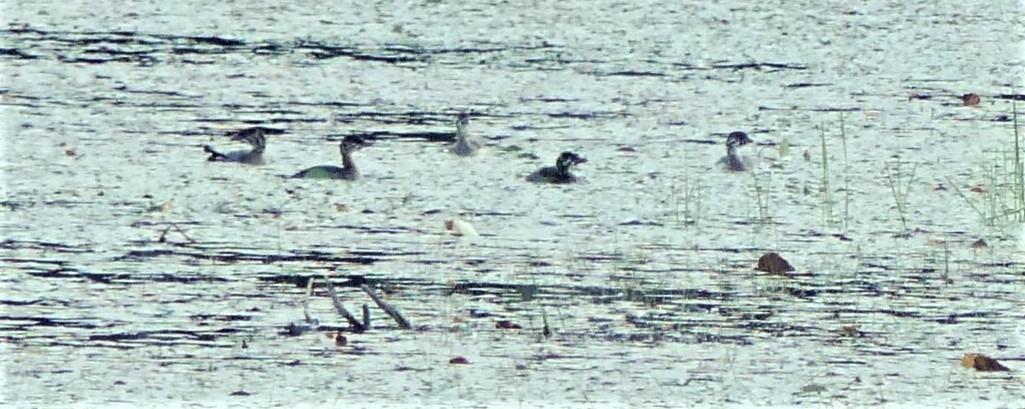
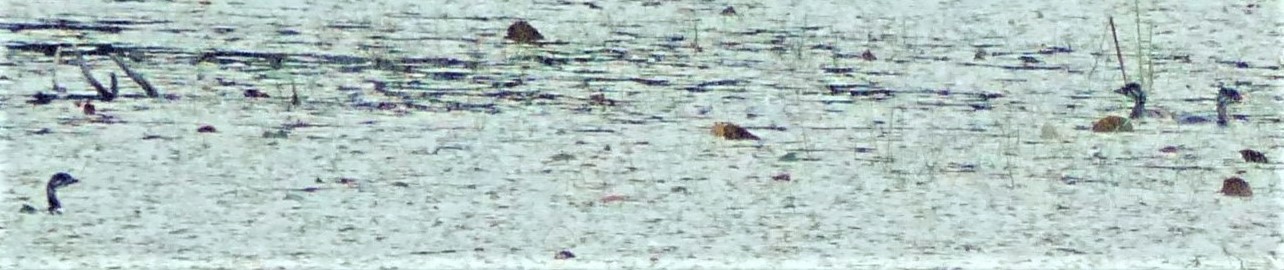
| Verbal Narrative & Description of Observation | Although my experience is that seeing water craft on this pond is not a common occurrence, a canoe was on the open water, at the north end of the pond, when I arrived to begin this observation from the shore at the north end of the pond. The occupants of the canoe were fishing, but within ten minutes of my arrival, the canoe and its occupants left the pond, and the grebes began appearing at the north end of the pond, and at 7:00 p.m. I took the images included with this report. During my observation the juveniles were observed diving/foraging and appeared to be having some success, bringing small fish (or possibly other smaller prey items) to the surface after diving. The juveniles were also observed begging food from the lone adult that was observed on the pond, during this observation. The begging behaviors included vocalizations by the juveniles, accompanied by the juveniles swimming to the adult and making physical contact with the adult, by using their mandibles to repeatedly make contact with the head area and mandibles of the adult. |
| Relative Size & Shape | Smaller than most other waterfowl commonly observed on this pond (e.g. mallards). Body sloped to posterior end with little to no tail feathers visible. |
| Head | Adult: Black stripe running across mandibles, perpendicular to the long axis of mandibles. Juveniles: Black and white striping on side of head and running partway down neck. |
| Wings | Relatively small wings, compared to body size of these birds, when wings raised. |
| IMPORTANT: What similar species were eliminated when making the identification and how was this bird different? | Distinctive black stripe running perpendicular to the long axis of the relatively short, compact, gray-colored mandibles used to identify the adult of this species present on the pond and rule out other diving waterfowl that might occur (e.g. common loons, other grebe species that might occur as migrants, and other diving waterfowl that might occur as breeding or migrant waterfowl on this pond (e.g. hooded mergansers (breeder) and ring-necked ducks (migrant)). For juveniles observed, distinctive black and white striping on sides of head, and running partway down neck, rule out other species of diving waterfowl which might breed on this pond (e.g. hooded mergansers and common loons). |
| Other Notes & Comments | Of interest, during my observations of pied-billed grebes on Sodom Pond this summer and fall, which began on August 16th, I was never able to confirm the presence of more than one adult on the pond at any time. Also, up until October 11th of this fall, I observed begging behavior exhibited by at least one of the juveniles and the adult grebe responding by continuing to catch and provide food. I have additional photos and notes I took on other dates, on the behavior of pied-billed grebes occurring this summer and fall on Sodom Pond, and I hope to compile all those and share them at some future date with whomever might be interested. |
| This report was written from notes taken: | During the Observation |
Vermont Atlas of Life Partners