| Common Name | Crested Caracara |
|---|---|
| Scientific Name | Caracara cheriway |
| Type of Report | Rare Species |
| Date of Observation | 03/04/2020 |
| Media | 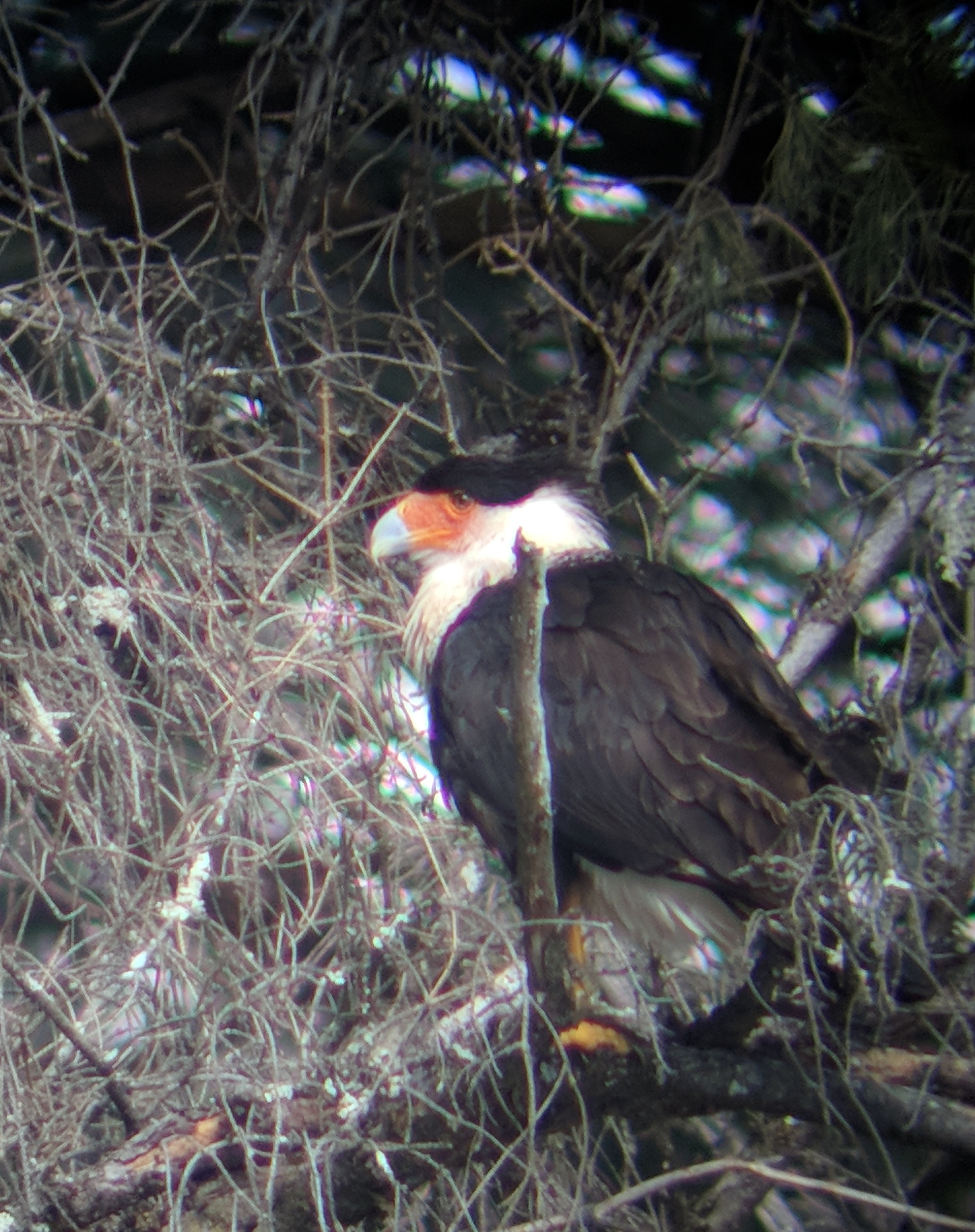 |
| Number Observed | 1 |
| Reporting Observer's Name | Nathaniel Sharp |
| Mailing Address | 94 Passumpsic Point West Fairlee, VT 05045 United States Map It |
| Email hidden; Javascript is required. | |
| Date Completed | 04/30/2020 |
| Names & Emails of Other Contributing Observers | Kent McFarland - |
| Latitude of Observation (enter 0 if unable to provide) | 43.635707 |
| Longitude of Observation (enter 0 if unable to provide) | -72.522687 |
| Place Name | field between Rt. 12 & Barnard Brook |
| Township | Woodstock |
| County | Windsor |
| Vermont eBird Checklist URL | ebird.org |
| Time of Day | 11:43 AM |
| Length of Time Observed | 2 hours |
| Maximum Estimated Distance from Bird (in feet) | 275 |
| Minimum Estimated Distance from Bird (in feet) | 200 |
| Noteworthy Weather Conditions | Occasional wind gusts and snow flurries, temps hovering in the mid-30s |
| Optical Equipment Used for Observation | Nikon Monarch 8x42 binoculars |
| Observer’s Previous Acquaintance With This or Similar Species | I've seen this species several times before when in Texas in Florida. I'd also been studying this species' patterns of vagrancy just a few weeks before this sighting while trying to get in touch with Mark Bessette about his Crested Caracara observation in 2018 in Alburgh. |
| I certify that any attachments included with this report were captured during this observation event. | |
| Description of Habitat | Bird was first spotted by Kevin Rice while perched in some buckthorn, boxelder, and sumac near the side of the road, after being flushed off a roadkilled skunk by passing cars. When I arrived the bird was perched about 50 feet up in a stand of norway spruces on the north end of the small field in between Route 12 and Barnard Brook. This spruce stand experienced some bright, warming sunlight in the mid- to late-afternoon. Several other large stands of spruces and pines were present to the south and west in the Marsh-Billings-Rockefeller National Historical Park, and there were also some large fields on private property to the north and east. |
| Behaviors Observed | While I observed the bird for approximately 2 hours, it didn't do much besides occasionally scratching and preening itself. It defecated once or twice, and frequently ruffled its feathers and slightly adjusted its position on the spruce bough it had chosen as a perch. Notably, the bird frequently kept one foot tucked into its body feathers, likely due to the cold winds and snow that blew through during my observation. |
| Description of Vocalizations | No vocalizations heard. |
| Verbal Narrative & Description of Observation | Below is the description of my observation added to my eBird checklist on the day this bird was discovered: "**Rarity--Potential 2nd State Record for Vermont** This bird was first discovered by Kevin Rice, who sent some photos and a description of the bird to Grae O’Toole at the Vermont Institute of Natural Sciences. Grae forwarded me the email from Kevin, and about a half hour later I arrived at the spot. The bird was first located at these coordinates (43.635807, -72.522558). Roadside parking is not advised, instead there is a gravel lot a few hundred feet north on VT-12N. Kevin originally reported that the bird was feeding on a road-killed skunk, which I noticed off to the side of the road even before I noticed the bird sitting on an exposed branch in a spruce stand at the north end of the field. Sarah Carline and I photographed the bird, and for the next 2 hours I remained with the bird helping other birders get looks at it and explaining the uniqueness of this rarity to passersby. Field marks noted include large, silvery-white bill, bright orange lores and facial skin, dark, crested head cap with a white face and white breast with thick dark streaks. The bird’s body is mainly black, with large, stocky orange legs and a dark-tipped white undertail that was very evident from the way it was perched. Over the 2 hours I watched the bird, through snow flurries and sunbursts, it remained perched in the same tree surrounded by spruces on either side. The bird would shift its position and shake its feathers from time to time, and was seen defecating, preening, and scratching infrequently. Notably, the bird kept its right foot tucked into its body feathers for the majority of this observation, likely due to the temperatures hovering around the mid-30s, with winds gusting to around 10-15mph." |
| Relative Size & Shape | About the size of a Red-tailed Hawk, with longer, more powerful legs and a prominent dark crest. |
| Head | Bright orange patch of facial skin visible from great distance, top half of head jet black with a prominent crest, nape and lower half of head white. |
| Feet & Bill | Massive, steely-blue bill and long, powerful, bright orange legs and feet. |
| Upper Back | Nape white, back entirely black, with a hint of black-and-white vermiculations (similar to the pattern on the chest) visible from some angles on the upper back. |
| Lower Back & Rump | Not very visible when perched. Appeared black overall, with some white on the rump continuing into the tail. |
| Wings | I was never lucky enough to see this bird fly, but other birders got excellent photos of its broad, paddle-shaped wings. During my observation, I noticed the upperside of the wings were entirely dark black, and views of the underside of the wings when preening allowed me to see the white primaries with black barring. |
| Breast, Belly, Flanks, Under Tail Coverts | Breast white, speckled with black vermiculations, flanks black, undertail coverts white. |
| Tail | Tail extended past wingtips when perched. Rump mainly white, with some black barring on the tail eventually ending in an all black terminal band. |
| IMPORTANT: What similar species were eliminated when making the identification and how was this bird different? | No species in North America, let along Vermont, shares the field marks of this bird, notably the orange legs and facial skin, broad, paddle-shaped wings, black crested appearance, and black and white streaked breast, tail, and primaries. |
| Other Notes & Comments | This bird remained in this same field in Woodstock, delighting birders from near andfar, and many passersby as well, until it was last seen on March 7th. Sex was not determined, neither was subspecies. |
| This report was written from notes taken: | During the Observation |
Vermont Atlas of Life Partners